Peter has written 156 articles

Ampli cash back app review: trading your purchase history for rewards

Ampli is a Canadian cash back app owned by Royal Bank of Canada. Ampli gives you cash back via Interac e-Transfer (whenever you have accumulated at least $15 cash back) on your everyday purchases that you make on your existing credit or debit cards. It figures out what purchases you made by reading the purchase history of your credit card(s) and/or bank account(s). In a way, you are selling your purchase history and profile, and you agree to be sent personalized offers, in exchange for cash back.

Cash back and other offers

The cash back you get through Ampli is separate and in addition to whatever rewards you are already earning on your credit or debit cards. At the time this article was published, the Ampli website lists 53 participating brands as having “cash back and offers”. Note, however, that not all of these brands participate in cash back offers — in a minority of cases the offer is that you get entries for cash prizes in their “Dreamstakes”.

The Ampli website does not list what specific offers are available. This is only available within its app, and you must be logged in to the app to see the details.

Ampli cash back offers

Some examples of current offers include:

  • Get $5 back on a $60 purchase at Indigo.ca
  • Get $10 back on a $50 purchase at Boston Pizza
  • Get 1% cash back at Petro-Canada
  • Get 1 entry into the Ampli Dreamstakes contest when you make any purchase at WestJet

Ampli WestJet offer

How Ampli might factor into your purchase decisions

One appeal of Ampli is that you can just link your accounts and then change nothing about your spending habits. While the number of Ampli offers appears to be increasing slowly, it’s up to you to determine whether the offers are for purchases you would already be making. Otherwise, you’ll find yourself watching the offers and purposely changing your spending habits in order to take advantage of the offers — that’s presumably one of the main ways that Ampli and its partners hope to make money.

If you deal with multiple banks and credit cards, in order to ensure that you get credit for applicable purchases, you have to link them all; otherwise you might make a purchase on a non-linked account and thus not get the cash back.

The Ampli sign-up process

The entire Ampli experience is done through its iOS or Android app.

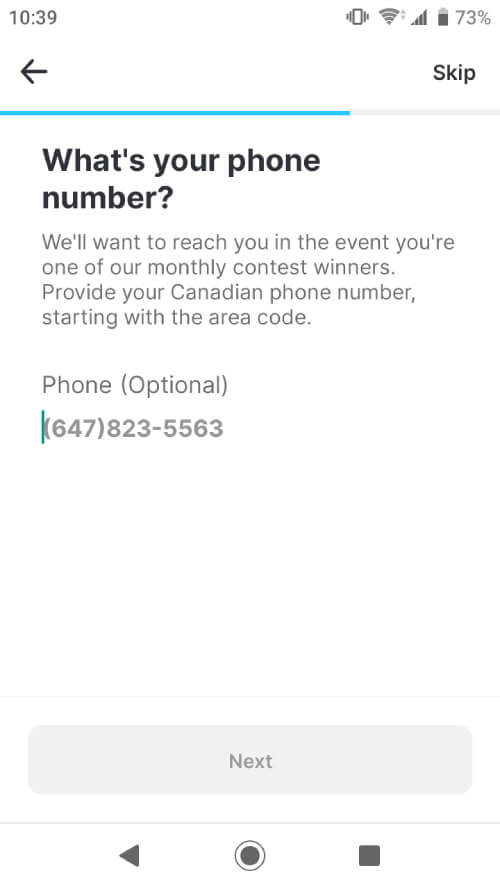
You must enter your first name, last name, and email address. It also asks for your postal code and phone number, and to sign up to receive promotional emails, but those are all optional; you can press the “Skip” button in the top right of those screens:

Ampli: optional phone number

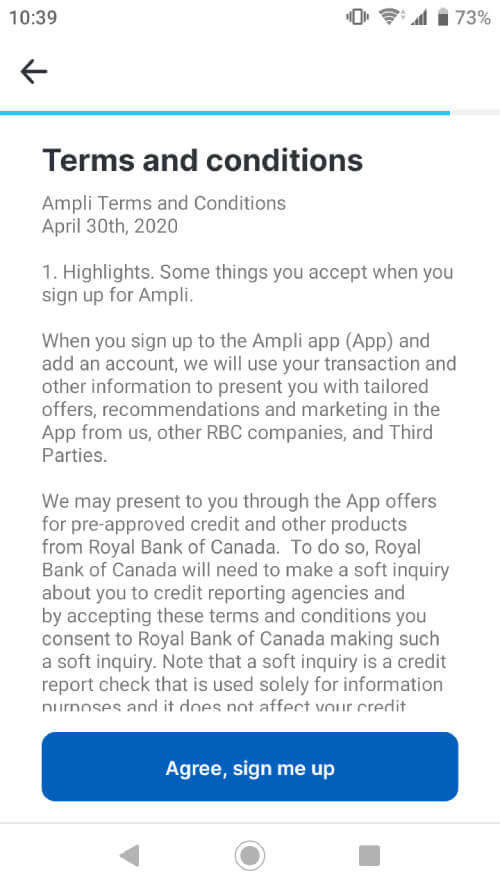
Part of the sign-up process is to accept the terms and conditions:

Ampli terms and conditions

You can also read these terms on the Ampli website, which includes information about how they use your information:

When you sign up to the Ampli app (App) and add an account, we will use your transaction and other information to present you with tailored offers, recommendations and marketing in the App from us, other RBC companies, and Third Parties.

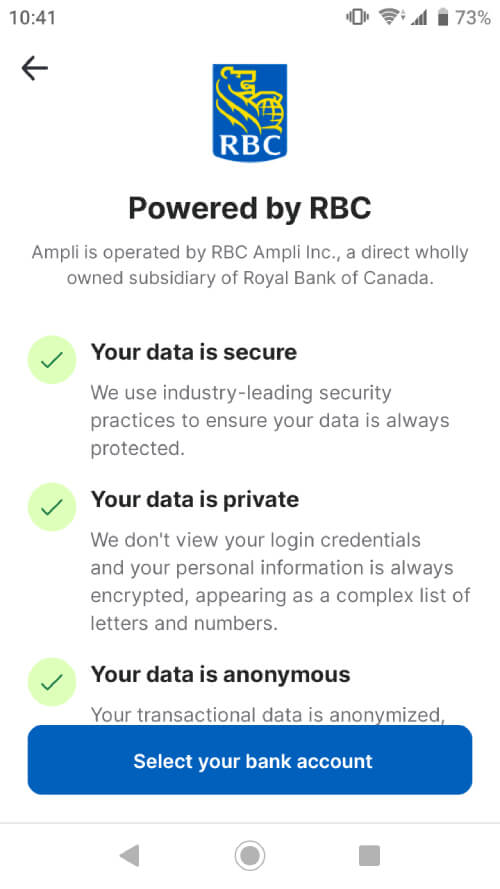
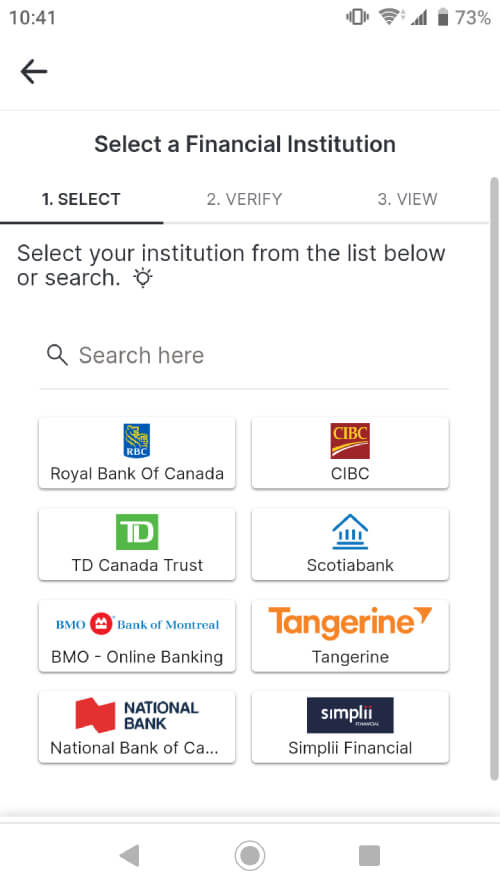
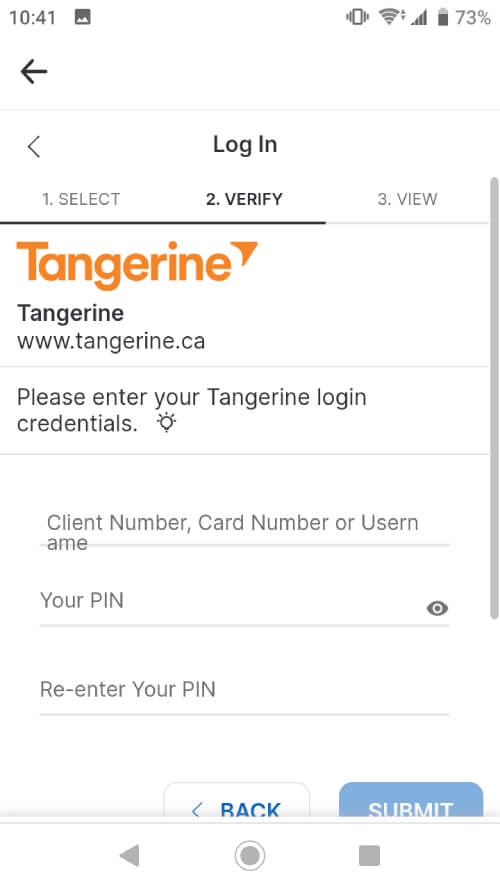
Linking a bank account or credit card consists of selecting the financial institution, then entering your login credentials at that financial institution.

Ampli bank account link: powered by RBC

Ampli bank account link: select a financial institution

Ampli bank account link: log in to the financial institution

I definitely paused a bit while signing up to consider how comfortable I am linking my bank account to the app. Obviously, this is the key step in order for me to participate in the offers, but I’m used to cash back being automatically tied to individual credit cards, or tied to me clicking on an affiliate tracking link. When it comes to Ampli, linking the bank account by signing in to it similar to how you link an account to accounting software, and security-wise, the fact that the app is owned by RBC gives it legitimacy. On the other hand, you must decide whether the cash back offers are worth all the trouble.

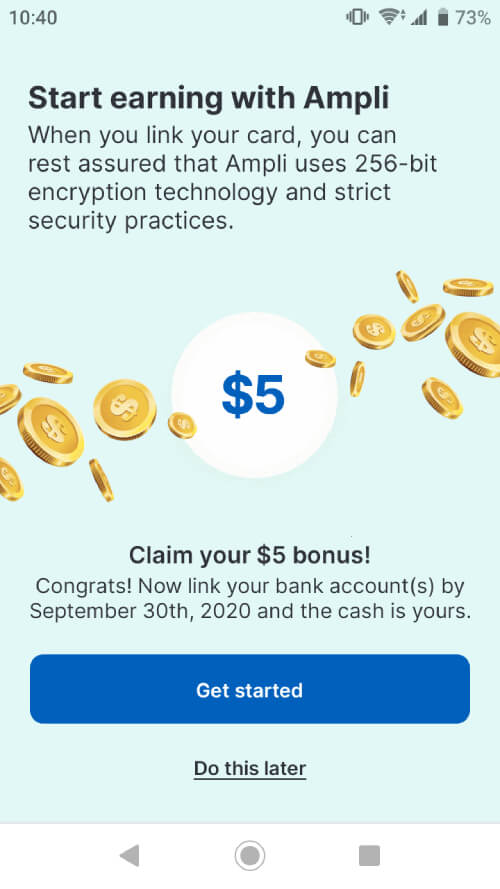
I was somewhat confused by the emphasis on bank accounts. At first, because it was prompting me to fulfill the requirements for a $5 promo (more on that next), I thought I was linking my bank account to receive payments:

Ampli link to claim bonus

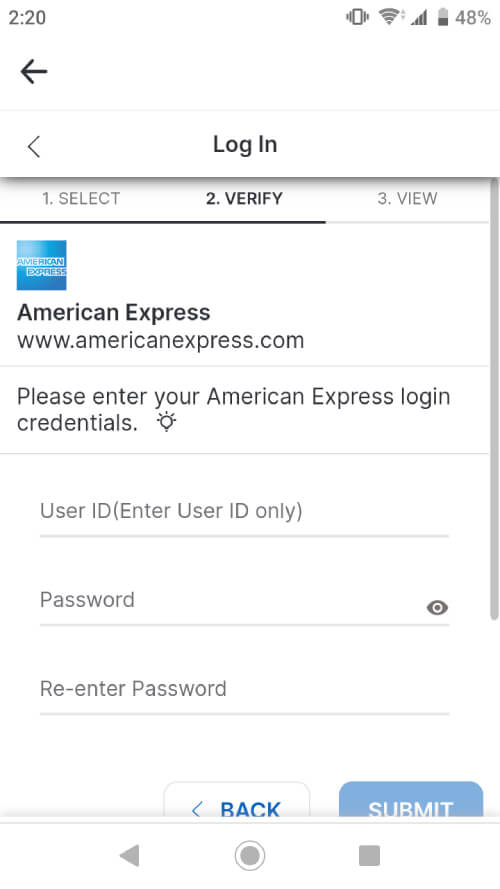
That was my wrong assumption, since they send you Interac e-Transfers when you withdraw the cash back, so the bank link has nothing to do with the withdrawal process — it’s entirely so that Ampli can read your transactions. In any case, you can link to credit cards that are tied to traditional bank accounts (such as at Scotiabank or TD Canada Trust), or search for a credit card company such as American Express:

Ampli link to American Express

Additional sign-up offers and how to withdraw

If you use the code AMPLI5 during sign-up, you will get $5 in your Ampli account for attaching a bank account or credit card. You must accumulate $15 in cash back before you can withdraw the money via an Interac e-Transfer.

There might be other promo codes available for new sign-ups, such as DOORDASH15 — until July 31, 2020, that gets you $15 cash back if you spend at least $15 with DoorDash.

Savers Roundup July 2020: Summer promos, EQ Bank joint accounts, and a primer on deposit insurance

Hands making a heart

2.00%+ savings accounts are getting rarer

At the top of our savings account comparison chart are Bridgewater Bank, Motive Financial, and EQ Bank, which all have interest rates of at least 2.00%. The only TFSA rate currently above 2.00% is Motive Financial at 2.05%.

There have been a few interest rate decreases since last month’s roundup, at MAXA Financial (from 2.00% to 1.80%), motusbank (from 1.65% to 1.40% for regular savings; from 1.75% to 1.60% for its TFSA), Peoples Trust (from 2.00% to 1.80%) and LBC Digital (from 2.05% to 1.65%).

Speaking of LBC Digital, we recently started to track its GIC rates on our GIC comparison chart, where it is at least tied for the lead on 1-year (2.10%), 2-year (2.05%), 4-year (2.15%), and 5-year (2.30%) terms. The top 3-year GIC rate is currently 2.10%, which you can find at both AcceleRate Financial and MAXA Financial.

Various versions of Simplii Financial and Tangerine Bank promotions

Simplii Financial has a new offer targeting some existing customers: 2.00% on new deposits made between July 1, 2020 and October 30, 2020. Others have reported getting an extension of a previous 2.80% offer through the end of August, and yet others have reported getting no new offer at all.

Over at Tangerine Bank, there is another round of targeted new deposit promos, although at 1.85%, it’s the lowest promo rate we’ve seen in a while. If you are an existing client and did not receive an offer, you can always try calling in to ask for a better rate. Someone reported getting 2.25% for 90 days on their entire balance.

Do you have a Canadian Tire credit card? If so, you might be eligible for a 2.00% savings account interest rate (only 0.20% above its current regular rate, but still something) if you sign up for emails and make a deposit by July 31.

We’re tracking the above promotions and more on our promos page.

EQ Bank joint accounts are here

On our forum, some people have been waiting for EQ Bank to support joint accounts since 2016. The wait for EQ Bank joint accounts is finally over. We’ve documented the process to set up an EQ Bank joint account.

Know the types of Canadian deposit insurance

Do you know the difference between CDIC coverage, provincial deposit insurance, and CIPF coverage? CFA Christopher Liew breaks them all down, explains why you should care about the differences, and provides tips on how to maximize your coverage.

Unfortunately, the question of what CIPF coverage provides — guaranteeing that you have shares, but not the value of your shares — is too relevant with the shut down of Pace Securities wiping out a lot of people’s hard-earned savings. The story continues to develop, with Pace Credit Union working on a solution.

More July reading

Dear Canadian businesses: It’s time to stop using cheques

Void cheque

Many of us Canadians stubbornly cling to cheques: we write cheques, we receive cheques, we deposit cheques. It’s time to stop. They’re expensive, insecure, and inefficient.

The status quo is comfortable

Many businesses know that it’s important to find ways to optimize operations and decrease costs. Studies show a significant decrease in business costs resulting from the switch from cheques to electronic forms of payment.

Unfortunately, change can be a big hurdle. As a Chartered Professional Accountant, sometimes when I make a recommendation to a client, such as moving to a different type of payment, I have to convince not just the owner of a business, but in the case of a larger entity or a charitable organization, I have to speak to several people on the board of directors, most of whom are quite reluctant to consider something new.

If you’re a cautious person, especially when it comes to payment processing, you’re not alone.

But don’t get stuck in the past

I was once speaking to a potential client. This client’s bookkeeper had been with her for a couple of decades, but the bookkeeper was about to retire.

As we spoke, she revealed to me that she does not trust technology and in fact she refuses to even use online banking. No matter how much I tried to explain that the only one in charge of her account is herself, she still preferred going to the branch for each transaction, often daily. She explained that the branch was close to home and she didn’t mind.

I did not take on this client. I just felt it would be too difficult to justify my rate in such an inefficient operation. If your business gets stuck in the past, you’ll have significantly fewer choices in terms of qualified people you can hire.

Cheques are not secure

Have you run into any of the following scenarios yet?

  • The bank makes a mistake and allows a fraudulent cheque to be processed.
  • The cheque does not reach the correct destination in the mail.
  • The recipient makes an error, such as misplacing the cheque.

On the more innocent side, a vendor can deposit a cheque but later forget, or they can make a mistake when reconciling bank statements, and then complain that they didn’t receive payment. Depending on how much time has elapsed, it can take time and resources to resolve the situation — as a busy business owner, what do you want to focus your time on?

Some more sinister things happen too, such as cases of actual fraud. Maybe it hasn’t happened to you, but it’s not as rare as you think. Below are two examples from my own experience.

A client issued a cheque and it cleared. No issue on our side. However, a while later the vendor complained about not receiving payment. It turns out they never received the cheque in the mail. It’s not very difficult for a fraudster to intercept mail and deposit it in a similarly named company, which is likely what happened based on the bank investigation that followed. The investigation took several weeks.

Another client had a cheque clear… but it wasn’t a cheque my client ever issued. Based on the investigation, it looked like the fraudster engaged in some photocopy magic and created a whole bunch of fake cheques with different account numbers and made deposits in various banks to see if anything cleared. In fact, when we saw a copy of the cheque it didn’t even have my client’s name on it.

The good news: because the second client had fully transitioned to using electronic payments, as soon as we logged in to online banking, the cheque was so noticeable it was practically yelling at us to do something. We immediately contacted the bank and got the funds back. The next day, the same thing happened! Clearly the fraudster caught on that ours was a real bank account. We again got the funds back, and unfortunately had to close this account. Transitioning bank accounts was relatively smooth because we had no cheques in transit.

The hard costs of cheques

A new business cheque book can cost anywhere from $100 to $300. A company with multiple bank accounts (such as CAD and USD), or a company that needs its logo on cheques, will sometimes spend more. Let’s say each paper cheque costs $1. I am not including the cost of mistakes or void cheques.

Then, if it’s impossible to hand someone a cheque in person, it needs to be mailed. Let’s say that’s $1 in postage. So, at a minimum, a company spends $2 just to get a cheque out the door.

As we know, banks charge fees. Some banks charge a fee for each cheque that clears. If you want to avoid this you might have to maintain a minimum balance or change to a different fee tier. And what about correcting for errors? A stop payment can easily cost $10 each. Each cheque can end up costing $3-$4.

Paper paper everywhere

If a business is organized, the owner takes the cheque stub, staples it to the original invoice, and neatly files it. Or maybe in your company, you pay someone else to do it. Some companies have very few payments, so it’s not a big deal. But some have a lot.

How much paper do you store in your office or in a storage space? How easy is it to find later? Is your paper secure and protected? Could the time and money managing paper be spent better elsewhere?

The physical can tie you down

As I write this at the beginning of summer 2020, when Canada is experiencing various shut downs related to COVID-19, I sometimes wonder about that potential client that visits her bank branch every day. I can only hope that her business is able to operate and that she’s safe.

How are you managing your business during the pandemic? Do you physically go to your office or bank? Does the bookkeeper drop off a stack of cheques for you to sign on your porch, in a plastic bag to protect them from the elements?

You’re not all in the office anymore

Imagine this: a charity needs to pay a supplier. The bookkeeper issues a cheque. Each cheque requires signatures from any two of the signatories on the board. They all live in completely different parts of the city.

Usually, an employee (or sometimes, a volunteer) has to get to each signatory and then bring the cheques back for mailing. Or maybe the charity requires that you come in to sign cheques on location. Even during normal times, this can be a bit of a pain.

Now, imagine you’re a signatory on the board and there is a pandemic. You are worried because you have an immuno-compromised family member. But you need to sign those cheques immediately because the charity is in financial trouble and it’s organizing an emergency online fundraiser and the web developer wants to be paid right now or else it won’t happen.

There are alternatives!

I hope I have convinced you that it’s time to start looking at other options. You probably know of, or have even used, some forms of electronic payment. But how can they be used by your business in an efficient manner?

There are many alternatives to cheques, including Interac e-Transfers, EFT/ACH, wires, and companies that specialize in accounts payable payment processing. In subsequent articles, I will explain these in more detail!

About the author

I am a Chartered Professional Accountant working somewhere in Canada. I provide controllership, training, and consulting services to small and medium sized businesses. I also work with non-profit organizations. I write only about my experiences in the business world and I am not selling or advertising any company or service, including my own. Audrey Silva is my pen name.

How to open an EQ Bank joint account

EQ Bank joint account

EQ Bank joint accounts have been long-awaited and delayed at least a couple of times (from some time in 2019 and “end of” February 2020). As of June 25, 2020, EQ Bank joint accounts are finally here.

Setting up a joint account with EQ Bank is relatively straightforward and can be done completely online. Once you have an existing account, you can add someone to that account using the EQ Bank mobile app or your browser. Here’s how to do it in your browser.

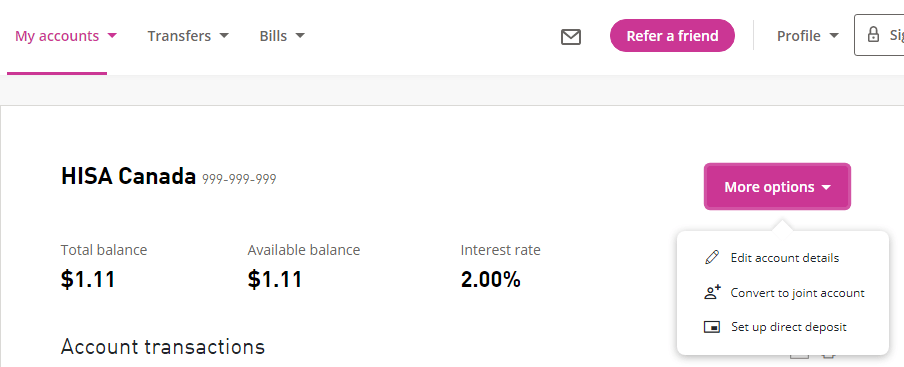
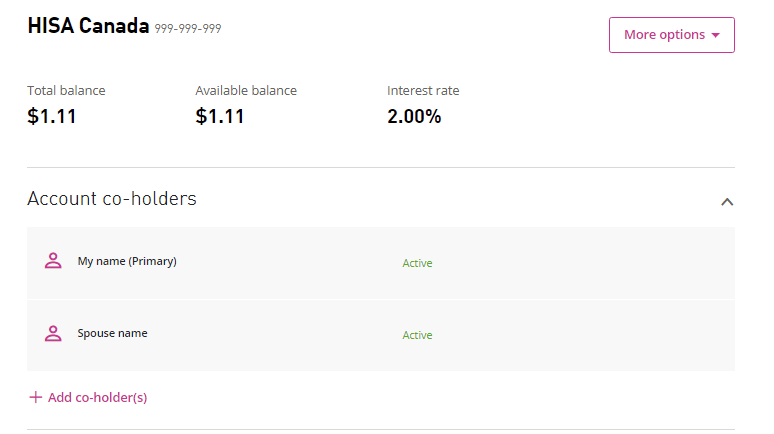
After you’ve logged in, browse to your account and then click the “More options” button. In the resulting dropdown menu, click the “Convert to joint account” link.

EQ Bank: Convert to joint account link

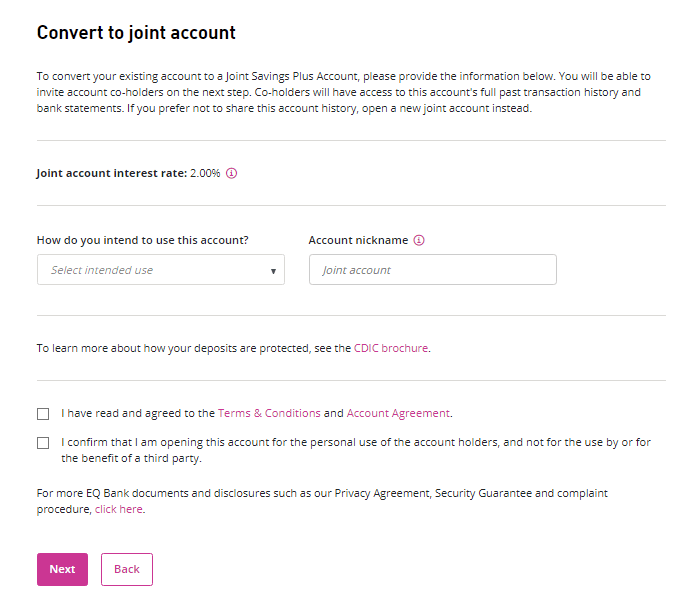
Then, complete the form for converting the account, which includes accepting the terms and conditions.

EQ Bank: Joint account conversion form

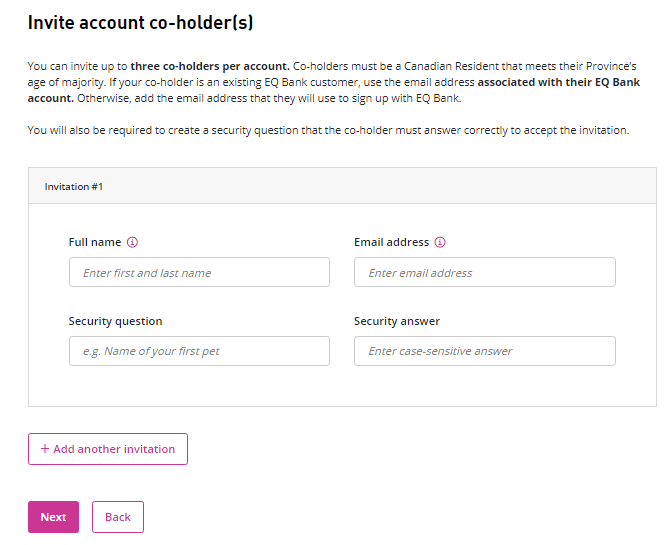
Next, add the account co-holder’s name and email address, and a temporary security question and answer that they’ll have to complete later.

EQ Bank: Joint account co-holder information

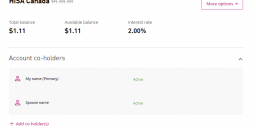
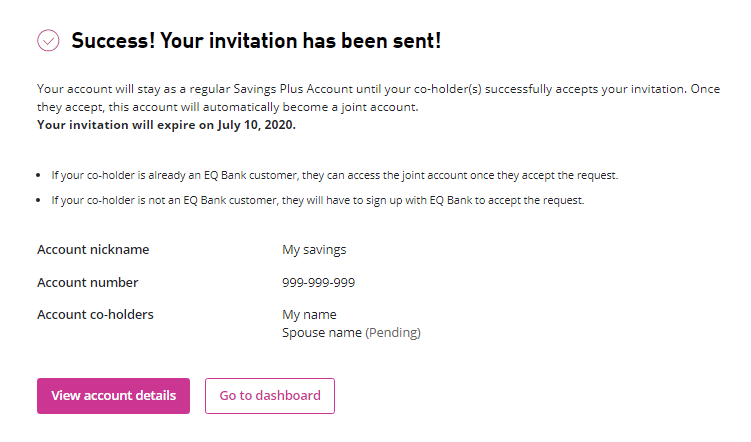
Your part is done. The confirmation page states that the co-holder will have 2 weeks to accept the invite:

EQ Bank: Joint account invitation confirmation

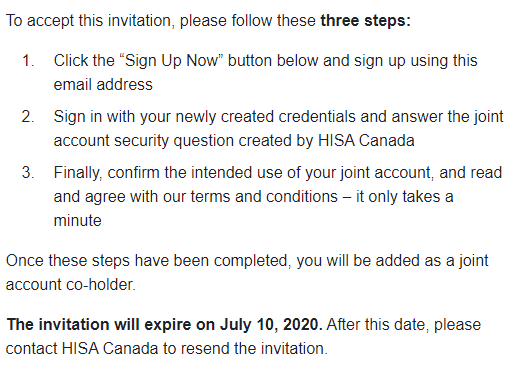
The desired account co-holder will then receive an invitation email with some general instructions on how to accept the invitation.

EQ Bank: Joint account invitation email

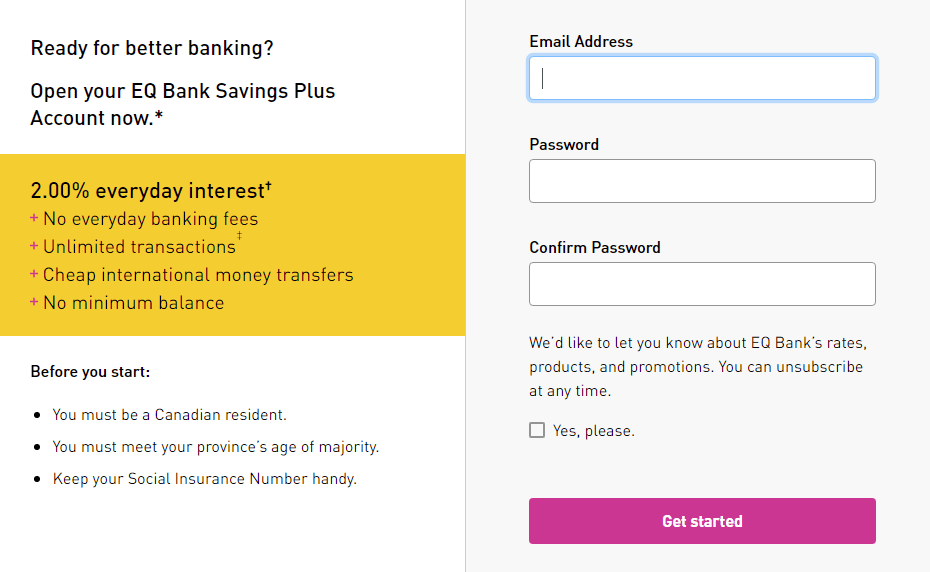
Once they click the link in the email, if they are already an EQ Bank customer, they can skip the next few steps and essentially log in and click a few buttons to complete the process. If they’re not yet an EQ Bank customer, the desired account co-holder will have to go through the account creation process, beginning by setting an email address to log in with, and a password.

EQ Bank: New account setup first step

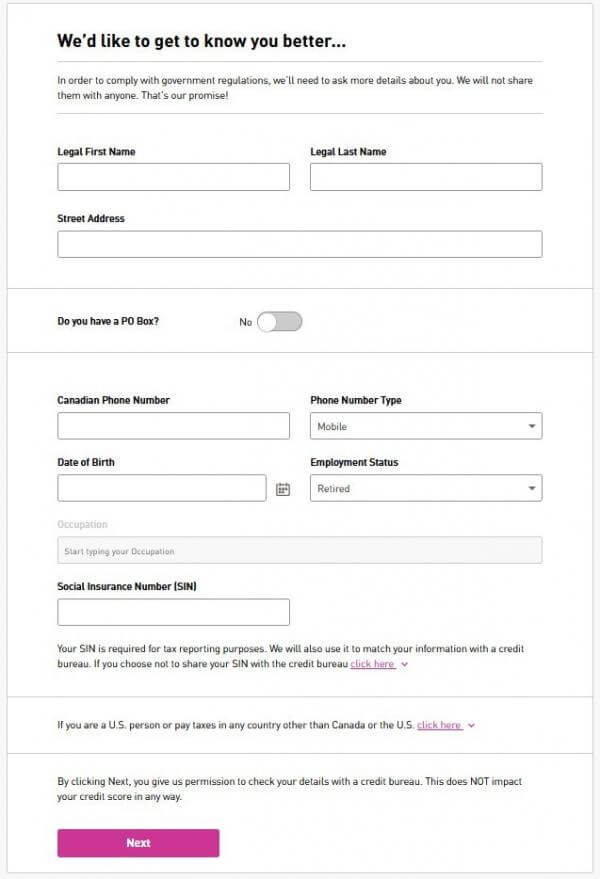
This will lead to a more complete sign-up form, where EQ Bank will collect their name and address, occupation information, Social Insurance Number, and more.

EQ Bank: New account setup second step

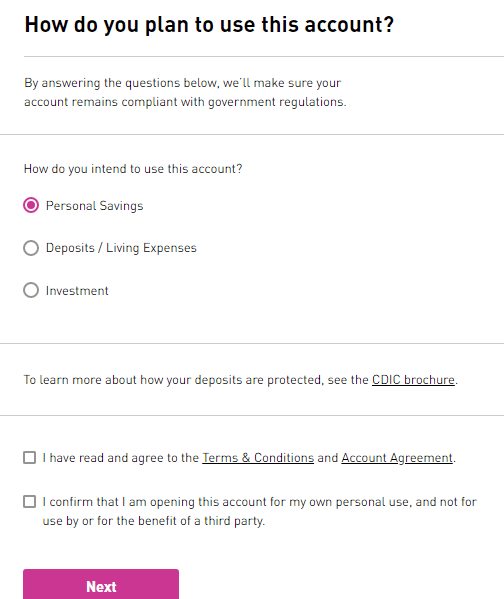
Next, the desired account co-holder must state the purpose of their account and agree to the terms and conditions.

EQ Bank: New account setup second step

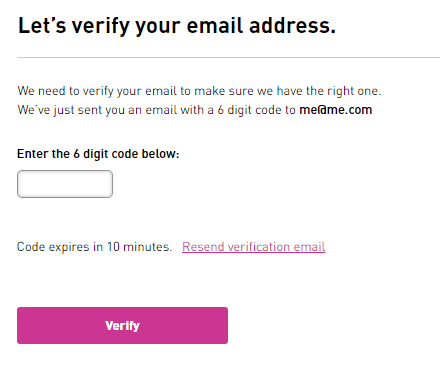
Lastly for the general account setup, they will have to enter a confirmation code sent to their email address.

EQ Bank: New account setup email confirmation

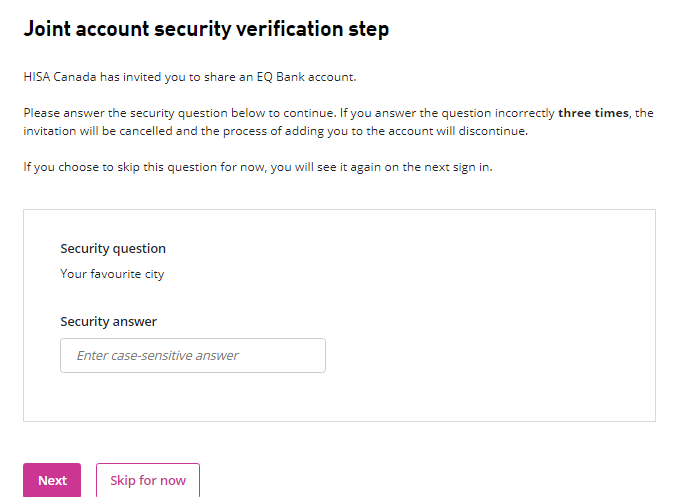
At this point, they can immediately complete the joint account setup by answering the security question you’d originally set up when sending the invite…

EQ Bank: Joint account security question

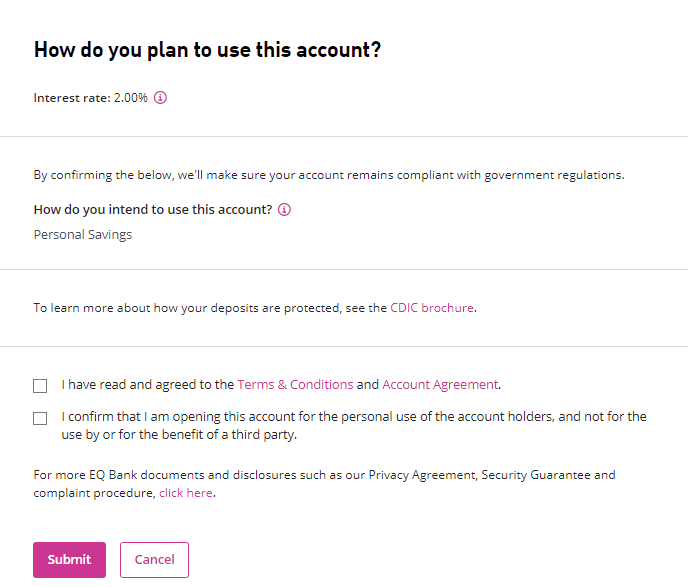
… and they must agree to the terms and conditions of the joint account.

EQ Bank: Joint account terms and conditions acceptance

This process is complete, and you will both have access to the joint account!

EQ Bank: Joint account terms and conditions acceptance

Technically the account co-holder will now have at least 2 EQ Bank accounts, since their original account still exists. You as the original account holder and primary co-holder might still only have 1 EQ Bank account, since your original account was converted to a joint account.

Canadian deposit insurance: CDIC vs CIPF vs provincial coverage. Should you care?

Canadian deposit insurance

You place a substantial amount of trust in financial institutions to take care of your money, whether you have a chequing account that has just enough cash to pay the bills or a Registered Retirement Savings Plan account that you are using to create a retirement nest egg.

What happens if a financial institution fails for any reason? As a Canadian investor, you should put your savings in a financial institution that is eligible for deposit insurance.

In Canada, there are three primary ways to safeguard your capital in case your bank or investment dealer fails:

  • Canadian Deposit Insurance Corporation (CDIC)
  • Provincial deposit insurers
  • Canadian Investor Protection Fund (CIPF)

The deposit insurance provided by each of these can protect your savings if the financial institution fails. As an investor, you don’t need to apply or pay for deposit insurance. They automatically insure your eligible deposits. However, there are differences in how CDIC, CIPF, and provincial deposit insurance work.

I’ll give you a breakdown of these insurance coverages to help you understand how they work and why they can be essential for you.

Canada Deposit Insurance Corporation

The CDIC is owned by the Canadian government. It insures your funds for up to $100,000 per eligible deposit category per financial institution. Deposit categories include non-registered funds, TFSAs, RRSPs, RRIFs, and more. In other words, for a given financial institution, you have separate coverage of up to $100,000 for each deposit category.

Most Canadian banks are members of the CDIC. Within each deposit category, CDIC covers term deposits, money orders and drafts, savings and chequing accounts, and travellers cheques. The CDIC also recently added USD deposits to what is eligible for coverage.

The CDIC has additional tools to help you understand what its insurance does and does not cover.

Note that CDIC coverage does not insure your deposits when it is a loss due to theft or fraud.

Quebec AMF

The federal deposit insurance protection is the same for all CDIC member institutions throughout Canada except in the province of Quebec. Quebec has its own insurance plan under the administration of l’Autorité des marchés financiers (AMF).

If a financial institution is covered by both AMF and the CDIC, deposits made in Quebec are insured by AMF. If the deposit is made outside of Quebec, then it will be insured by the CDIC.

The maximum collective coverage from both agencies cannot exceed $100,000 per depositor for each insured category per institution.

Provincial deposit insurance

Each of the ten provinces in Canada has a provincial deposit insurer that protects provincial credit unions:

Alberta, BC, Manitoba, and Saskatchewan provide unlimited coverage. All of the other provincial insurers — with the exception of Quebec — provide more than $100K coverage.

There have been cases where coverage by a particular financial institution has changed, such as when Coast Capital Savings converted from a BC credit union to a national bank. In that case, they outlined transitional coverage.

7 of the financial institutions on our high interest savings comparison chart are Manitoba credit unions, so let’s dig a bit deeper into the relevant coverage. As per the Deposit Guarantee Corporation of Manitoba (DGCM), they provide a “100% guarantee of all deposits in Manitoba credit unions regardless of where the depositor resides. Deposits guaranteed include chequing/savings accounts, term deposits/GICs including TFSAs, RRSPs, RRIFs, RESPs. The guarantee does not cover non-deposit instruments, examples of which include common shares, surplus shares, preferred shares, mutual funds and self-administered RRSPs that are not deposits (e.g. equity shares, mutual funds).”

Some key elements of how the DGCM operates include:

  • Credit unions are expected to maintain capital and liquidity levels above legislated minimum standards.
  • The DGCM maintains a Guarantee Fund, funded by quarterly premiums paid by Manitoba credit unions.
  • The current target size of the Guarantee Fund is 1.05% to 1.30% of deposits and is based on a statistical model with over 400,000 scenarios.
  • If for some reason there is insufficient money in the Guarantee Fund if a credit union were to fail, other remedies are available in The Credit Unions and Caisses Populaires Act of Manitoba, including the ability to raise additional funds from all Manitoba credit unions, arrange mergers between credit unions, and approach the Manitoba government for financial assistance.

Canadian Investor Protection Fund

The CIPF protects the investments held by financial institutions like banks, companies that sell investment products, and investment dealers.

The institution needs to be a CIPF member for your funds to be insured. Here is a breakdown of CIPF coverage limits:

  • Up to $1 million for general accounts combined like cash accounts, margin accounts, Tax-Free Savings Accounts
  • Up to $1 million for all registered retirement accounts combined like RRSPs, Registered Retirement Income Funds (RRIFs) and Locked-In Retirement Accounts (LIRAs)
  • Up to $1 million for all Registered Education Savings Plans (RESPs) combined where the client is a subscriber of the plan.

One of the main things to note is that cash deposits are covered by the CIPF, but the value of other investments are not. Suppose you held 100 shares in Company A through an investment firm (Company B). If the investment firm were to fail, the CIPF would ensure that you still hold the 100 shares in Company A, but without any guarantee of the value of those shares.

Wealthsimple Cash: when you have CIPF coverage but not CDIC coverage

The launch of Wealthsimple Cash highlighted a potentially confusing situation: Wealthsimple Cash advertises features similar to a normal bank account (albeit with hybrid chequing and savings account features) but does not have CDIC or provincial deposit insurance; it has CIPF insurance. The money held in your Wealthsimple Cash account is deposited in trust (through Wealthsimple’s subsidiary ShareOwner Investments Inc.) with one or more of the big six Canadian banks, otherwise known as “domestic systemically important banks”.

Suppose you had $1,000,000 deposited in your Wealthsimple Cash account:

  • If one of the big six banks where your money is deposited goes bankrupt, you are not guaranteed to get your money back, because this deposit is not eligible for CDIC coverage.
  • If Wealthsimple goes bankrupt, you are guaranteed to get your money back.
  • If ShareOwner Investments Inc. goes bankrupt, you are guaranteed to get your money back.

In other words, with Wealthsimple Cash, you technically have higher insurance coverage through the CIPF than through the CDIC, but you are not covered if one of the big six banks fails. It is significantly more likely for Wealthsimple or its subsidiary to fail than for a big six bank to fail, but it is worth noting the details of what is not covered.

So should you care about the difference between CDIC, CIPF, or provincial deposit insurance?

Between CDIC and provincial coverage for credit unions, I don’t see much difference in terms of the effective safety of your deposits. Provincial coverage outside of Quebec is actually higher than with the CDIC, so that might factor into your decision of which institution to go with. The CDIC provides a more explicit government backing, although as per the details provided by the DCGM (Manitoba), provincial insurance is extremely robust.

In many cases, the CIPF provides coverage for a different type of investment than your standard savings account or GIC, but there are examples such as Wealthsimple Cash that blur the line.

Deposit insurance strategies to extend your coverage

Generally, whether you are looking at a financial institution with CDIC, provincial deposit insurance, or CIPF coverage, you can spread your risk and extend your coverage by depositing your funds for all account types in multiple financial institutions.

Some savers use a strategy to effectively extend their CDIC coverage by splitting their deposits between related companies. For example: Peoples Trust is covered by the CDIC for up to $100,000 in each of the eligible deposit categories, and Peoples Bank has separate and equal coverage. Peoples Trust and Peoples Bank are both owned by Peoples Group, and have similar interest rates for their savings accounts.

If you have maxed out your CDIC coverage on one account and need more coverage but at the same interest rate, you could open an equivalent account with the other bank. Another advantage is consistency in the brand and service experience, if a customer likes dealing with Peoples companies in general.

However, it might be wiser to spread out the risk and deposits to another completely separate bank. If Peoples Group or one of its subsidiaries were ever in danger of bankruptcy, then the related companies would have an increased risk of bankruptcy as well. It would be quite a hassle to go through two separate CDIC insurance claims at the same time, and your money would be tied up during that period.

Conclusion

As a Canadian, your deposit insurance options are diverse. If you play your cards right, 100% of your deposits could be covered by some form of deposit insurance. Even though Canadian banks are among the safest in the world, you never know what can happen in the future!

Author Bio – Christopher Liew is the creator of Wealthawesome.com, where he shares money tips and guides for his readers. He’s a CFA Charterholder who has been featured on Yahoo Finance, MSN Money, and The Motley Fool. Read about how he quit his 6-figure job to travel the world.