Savers Roundup December 2022: One more rate increase; Oaken Financial and HSBC Canada have been sold

Hot chocolate

The Bank of Canada made its final key interest rate decision of 2022, which was a 50 basis points increase. 2022 has been the year of inflation and rising interest rates. Rewind back to the beginning of 2022:

  • The Bank of Canada hadn’t started raising rates yet
  • Wyth Financial had the highest savings account interest rate on our comparison chart at 1.55%
  • Hubert Financial had the top 1-year GIC on our GIC comparison chart at 2.00%, and the top 5-year GIC at 3.00%
  • The topic of brokerage investment savings accounts was barely discussed
  • We were discussing short-term promos hovering around 2.00%

In the present day:

The year is not quite done, and we’re likely to see more savings account increases (with the most recent changes at Canadian Tire Bank from 2.40% to 3.00%, Achieva Financial from 2.95% to 3.25%, and EQ Bank’s TFSA from 2.50% to 3.00%). GIC rates will also fluctuate, although potentially in the other direction, as EQ Bank and Motive Financial have recently decreased some of their GIC rates.

Acquisition news

Non-inflation / non-rate news has been trying to grab headlines recently:

TFSA reminders

Lastly, the additional TFSA contribution room coming in 2023 is $6,500. If you have existing TFSA funds that you would like to transfer to another financial institution, consider withdrawing it before the end of December and then re-contributing it in January in order to avoid direct TFSA-to-TFSA transfer fees and administration work.

Savers Roundup November 2022: It’s 5.00% somewhere

Clicking glasses over 5%

All rates trending to 5.00%

After what seemed like a brief slowdown or pause, GIC rates have been increasing again, especially for shorter terms. One month ago, Resurrection Credit Union’s (Ontario only) 5.00% 1-year GIC rate stood out. Now, the 1-year GIC rate leader on our GIC comparison chart is Peoples Trust at 5.20%, and it’s one of a few financial institutions with 1-year rates higher than their 5-year rates. EQ Bank, Oaken Financial, and Wealth One Bank of Canada all have 1- through 5-year GIC rates of at least 5.00%.

Half of the savings accounts on our comparison chart sport a 3.00% interest rate or higher, with Ontario-only Saven Financial leading at 3.75%, followed by nationally-available Oaken Financial at 3.40%. The next key interest rate decision from the Bank of Canada is scheduled for December 7.

You can get up to 3.80% in an Investment Savings Account through your brokerage. Interest rates in such accounts usually lag traditional savings account quite significantly, but have been trending upward.

What’s more, you can get interest rates that almost rival GIC rates via at least a few savings account promotions, including:

TFSA contribution limit increasing to $6,500?

The TFSA contribution limit for 2023 is all but guaranteed to be $6,500, which would be up from $6,000 in 2022. This increase is thanks to inflation, as the TFSA contribution limit is indexed to inflation and rounded to the nearest $500 increment.

Bye bye Wyth Financial

Just over a year ago, Concentra Bank renamed itself to Wyth Financial and made its savings account generally available. Now that Equitable Bank has completed its acquisition of Concentra Bank, Wyth Financial is being retired. No new Wyth Financial accounts can be opened, existing savings accounts will be closed, and GIC accounts will be serviced until they mature. On the Wyth Financial website, new customers are being directed to explore EQ Bank.

Credit card news

The STACK Prepaid Mastercard’s recent changes are not good: first, it reinstated its previously waived foreign currency exchange fee, and now it will start charging a monthly fee if you don’t spend at least $350 per month.

We’ve published a new comparison of some promising small business card solutions: Float and Caary. They both allow you to create employee cards with no annual fee, but there are quite a few meaningful differences between them.

Float and Caary comparison and review: prepaid and credit card solutions for small businesses

Credit card comparison

As the owner of a 12-person small business, I’ve been on the lookout for a no-fee or low-fee Canadian credit card solution that enables me to conveniently issue employee cards for both CAD and USD purchases. I want to eliminate the need for employees to have to use personal cards (and then have them wait to get reimbursed), and cut down on sharing company cards. Float and Caary caught my attention, and I’ve tried them both.

What they do

Float and Caary have many similarities. They’re both no-fee business cards, and you can issue both physical and virtual cards to employees. You can customize the spending limits and even expiry dates (especially handy for a one-off purchase) per card.

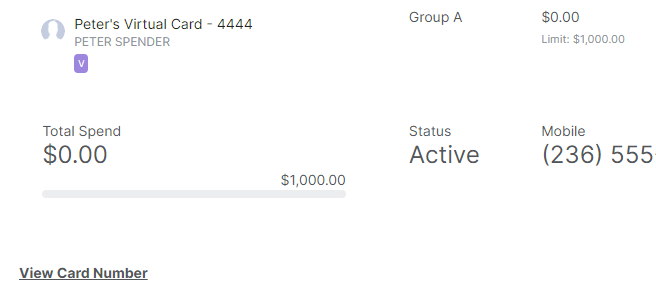
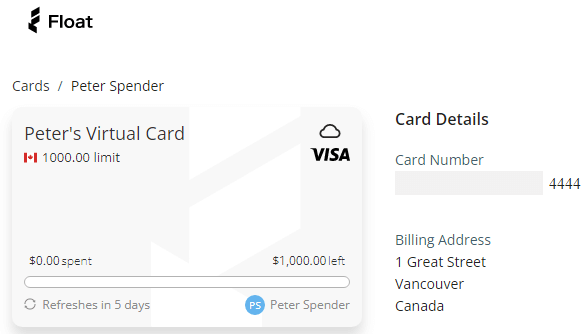
Here’s a Float virtual card:
Float virtual card

Here’s a Caary virtual card:
Caary virtual card

At the moment, neither card can be added to Apple Pay or Google Wallet.

They offer receipt capture, accounting software integration, and other expense management features.

Rewards and (lack of) insurance

Float gives you 1% cash back on all purchases, and Caary gives you 1.5% cash back on all purchases. Neither card has traditional benefits that you might find on credit cards, such as travel or mobile device insurance.

Forex spending

Until very recently, they both waived foreign currency exchange fees (which are typically 2.5%). When Float announced USD cards (that you can pay off using Canadian-based USD bank accounts), they added a 1.5% foreign currency exchange fee on their CAD cards. Caary still does not have a foreign currency exchange fee.

One is a prepaid card

Float and Caary’s cards are both issued by Peoples Trust – in Float’s case, it’s a Visa and in Caary’s case, it’s a Mastercard. However, the Float card is a prepaid card, so you need to preload money from your bank account. Caary’s card is a credit card whose balance you have to pay off every month.

Application and setup process

Both application processes are conducted entirely online. I found Float’s application process to be a bit more involved and a bit longer, as I had to submit several corporate documents and documents about co-owners. This took a few days of back and forth. With Caary, after submitting the application and connecting my bank account, I was approved in a few hours. Float appears to do more to inspect your company, whereas Caary appears to be more concerned about your bank account balance and history.

With Float, your total spending limit depends on how much money you preload. With Caary, your total spending limit is fixed, like a standard credit card.

Creating cards and using their online interfaces in general is very easy. This is impressive fintech.

Float will automatically mail its physical cards to Canada or the US. Caary only mails its physical cards within Canada.

Both Float and Caary have very quick email support – I got a response within a couple of hours – and Float also has online chat support.

Company profile

Looking at the companies’ history and founders, Float has more of a tech background, whereas Caary has more of a traditional finance background. Float also has a slicker website and admin panel interface, as well as a bigger social media following and fancier marketing.

Both are worth trying

At first, I tried Float. It was going smoothly and I was ready to recommend it to others! But only a few weeks after I had started using Float, they announced the introduction of their USD cards and the resulting 1.5% foreign exchange fee on their CAD cards. This is probably a net benefit for many companies, but I didn’t want the complexity of having to manage multiple card balances. That’s what drove me to try Caary instead, and it has functioned exactly as advertised so far. It is also attractive that Caary is a traditional credit card, because then I don’t have to manage the prepaid balance.

Both Float and Caary provide promising spending card solutions that solve some real small business needs, and I can say from experience that they are worth considering.


Savers Roundup October 2022: Wealth One GIC specials; credit card surcharges loom

Pay Here sign

Continuing a recent trend, there has been very little action in GIC rates. One of the exceptions is Wealth One Bank of Canada, with some standout rates until October 30: 1-year at 4.68%, 2-year at 4.88%, 3-year at 5.08%, 4-year at 5.08%, and 5-year at 5.18%. Its 1-year GIC rate of 4.68% trails Peoples Trust (at 4.80%) as well as Oaken Financial and Tangerine Bank (both at 4.70%), but the rest of its rates top our GIC comparison chart.

Savings account interest rates have still been increasing, but slower than previously. Since the Bank of Canada’s September 7th key interest rate hike of 75 basis points, only about half of the financial institutions on our savings account comparison chart have increased their savings account interest rates. The average increase is 33 basis points, or 44% of Bank of Canada’s increase. This is a far cry from what happened in the month following the Bank of Canada’s 100 basis points rate hike on July 13th, where the vast majority of savings accounts that we track went up, and by an average 61 basis points increase, or 61% of the Bank of Canada’s increase.

There are now 4 savings accounts offering at least 3.00%, and 3 of them are nationally available at Motive Financial, Oaken Financial, and Wealth One Bank of Canada.

Here is a list of new deposit promos to consider this fall:

Mergers, credit card surcharges, and more deals

Savers Roundup September 2022: Why GIC rates haven’t been increasing

Hoodoos, slow to change like GIC rates

With last week’s key interest rate increase from the Bank of Canada, the five increases this year have been as follows:

  • September 7: 0.75%
  • July 13: 1.00%
  • June 1: 0.50%
  • April 13: 0.50%
  • March 2: 0.25%

Every increase has been met by an equivalent increase in banks’ prime lending rates. By and large, financial institutions have increased their savings account interest rates accordingly as well, albeit not by as much as savers would like.

GIC rates have not been as well-correlated. Between January 1 and July 1, 2022, the top 1-year GIC interest rate on our comparison chart went up from 2.00% to 4.15%, but since then it’s only gone up to 4.60%. During that same period, the top 5-year GIC interest rate went up from 3.00% to 5.00%, but since then it’s only gone up to 5.10%. At a few financial institutions, GIC rates have actually gone down recently.

We spoke to a few financial institution representatives, and got a roughly consistent answer: there are many factors affecting GIC interest rates, such as a financial institution’s various alternative funding sources (including the Canadian Dollar Offered Rate) and good ol’ competition. But the main reason why there isn’t as much correlation between GIC rates and the Bank of Canada’s key interest rate is that GIC rates are more forward-looking. Earlier in the year, there was a greater expectation of interest rates increasing, thus we saw bigger increases in GIC interest rates. Looking ahead to 2023, the Bank of Canada isn’t currently expected to increase its key interest rate as much as it did in 2022, thus GIC rates have plateaued, at least for now.

Savings account interest rates have kept climbing. Ontario-only Saven Financial tops our savings account comparison chart at 3.30%, followed by Motive Financial and Oaken Financial at 3.00%. One final note: if you have an investment brokerage account, you might be surprised at some of the CDIC-insured Investment Savings Accounts, which are earning up to 2.85%. Many of these Investment Savings Accounts are offered by the big banks, whose paltry regular savings accounts interest rates continue to languish.