Financial education is something that is often overlooked in school. Most young people leave high school or even college with only the basics of budgeting or credit, and very few of us are taught how to plan for the future, save effectively, or invest our money with intention. As a result, many young individuals feel unprepared when it comes to managing money. It can feel overwhelming, confusing, and even discouraging, especially when you factor in the high cost of living, tuition, student loans, and the pressure to get ahead financially at a young age.
This is why building a financial foundation early matters so much. At this stage of life, personal finance is less about making large amounts of money quickly and more about developing habits, understanding how money works, and building confidence in your decisions. The earlier you start, the more time you have to learn, make mistakes when the stakes are low, and let your money work for you. Even small actions now can create long-term benefits, not just financially, but mentally as well.
My perspective as a student learning along the way
I am a 20-year-old, fourth-year college student, and like many people my age, I am learning as I go. I am balancing tuition, part-time work, and everyday expenses while trying to make thoughtful financial choices. I do not have a high income, and I am not investing thousands of dollars, but what I have learned is that starting early changes the way you think about money. It builds discipline, patience, and a sense of control over your future.
There is also an important mental side to this. Without a solid foundation, it is possible to get lucky in the short term and still end up worse off later. Making money without understanding risk, planning, or long-term goals can lead to poor decisions and bigger losses down the line. Building a foundation shifts the focus away from luck and toward sustainability.
It is also not easy to stay motivated when building good habits only seems to earn you a few dollars in the short term. This is where delayed gratification comes in. You are choosing future stability over immediate rewards, which can feel difficult when you are young and want to enjoy your life. The goal is not to deprive yourself. It is to strike a balance where you can still live your life while putting simple systems in place that support your future self.
Understanding the basics: saving, investing, and setting goals
The first step to building a financial foundation is understanding the basics and how different financial tools serve different goals. Saving and investing are often grouped together, but they play very different roles. Saving usually means putting money aside in a safe and accessible place. This money is meant for emergencies, short-term goals, or expenses you expect in the near future. Investing, on the other hand, is about growing money over time by accepting some level of risk in exchange for potential returns.
When thinking about investing, it helps to focus on three key factors: time, risk, and return. Your time horizon refers to how long you plan to leave your money untouched. Generally, the longer your time horizon, the more risk you can afford to take, because you have time to recover from short-term market changes. Higher risk options often come with higher potential returns, while lower risk options offer more stability but slower growth.
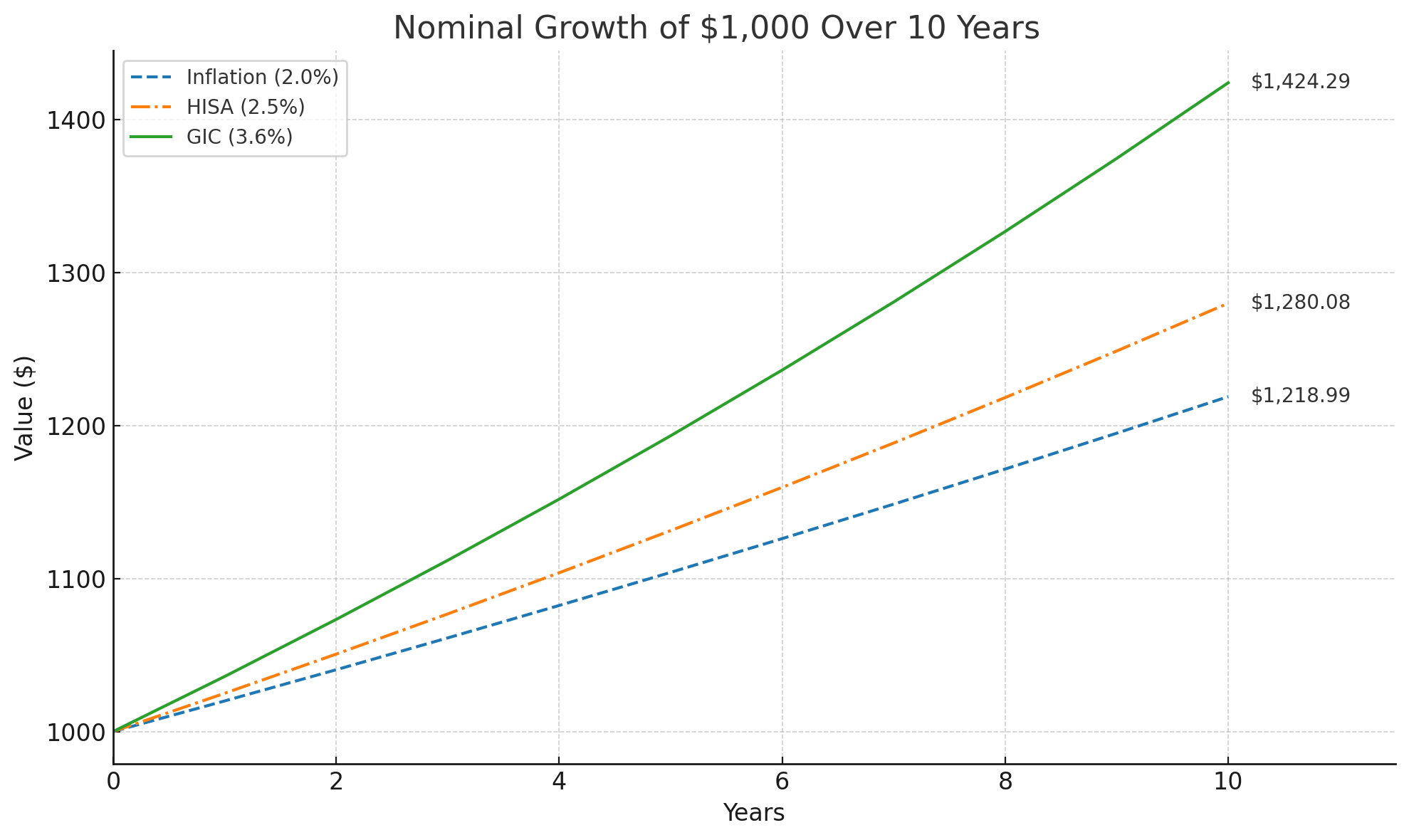
Investing does not always mean stocks. For more conservative investors or specific goals, options like Guaranteed Investment Certificates (GICs) can play an important role. GICs offer predictable returns and lower risk, making them useful for people who value security or are saving toward a specific timeline. The key is matching the tool to the goal rather than simply chasing returns.
Why time and compound growth matter
Time is one of the most powerful tools young investors have. Thanks to compound growth, the money you earn can start earning money itself over time. This effect becomes more powerful the longer your money stays invested.
For example, investing $50 a week adds up to about $2,600 a year. Over ten years, that is $26,000 in contributions. If those contributions earn an average annual return of around 6%, the total value after 10 years would be over $35,000 (according to this compound interest calculator). The advantage comes from consistency and time, even if you don’t have large one-time contributions.
This is why starting early matters more than starting big. Someone who begins investing small amounts in their twenties can end up ahead of someone who waits until later, even if the second person contributes more money. For example, a $50 per week contribution at a 6% annual return over 30 years beats a $100 per week contribution at the same 6% annual return over 20 years, even though the latter scenario contributed a third more!
Time allows growth to compound and gives you room to learn without pressure.
Why the TFSA is more than just a savings account
One of the most important tools for young people is the Tax-Free Savings Account, or TFSA. Despite its name, a TFSA can be much more than a savings account. It is a registered account that provides tax advantages. Inside a TFSA, you can hold different types of investments, including a savings account, ETFs, stocks, GICs, and more.
This distinction matters because many people open a savings account within a TFSA and assume that’s all it can do, and I was one of them! In reality their money may just be sitting in cash earning minimal interest (especially if it’s in a big bank). That is not necessarily a bad factor, especially for short-term goals, but it is important to understand that the TFSA itself is just the container. What you put inside it determines how your money grows.
A major benefit of a TFSA is that any growth inside the account is tax free. You do not pay tax on interest, dividends, or capital gains earned inside the account. You also do not have to report buying and selling investments within your TFSA on your tax return. For someone who is still learning, this makes the process much less intimidating.
TFSA basics every person should know
TFSA contribution room starts accumulating when you turn 18, regardless of your income (or whether you even have income). Each year, the government sets a contribution limit, and unused room carries forward. This means many young people already have several years’ worth of contribution room (which amounts to tens of thousands of dollars) available by the time they open their first TFSA.
Withdrawals from a TFSA are flexible. You can take money out at any time, and whatever amount you withdraw gets added back to your contribution room the following year. However, it is important to be careful. If you withdraw money and then re-contribute it in the same year without having enough available room, you can accidentally over-contribute and face penalties. Tracking your contribution room is essential.
TFSA rules are not complicated, but small mistakes can be costly, which is why understanding the basics early matters. The official CRA website’s TFSA documentation is comprehensive. Make the learning a bit more fun with this TFSA quiz!
What I did when I opened my first TFSA
I opened my first TFSA when I turned 18. I did not have a lot of money, but I had saved $1,000 and decided to use it as a learning opportunity. Instead of letting it sit in cash, I used that money to buy an ETF.
That decision was not about chasing high returns. It was about starting. It helped me understand how investing actually works, how markets move, and how it feels to see your money fluctuate. That experience alone made investing feel less intimidating.
Buying an ETF allowed me to invest in a diversified group of companies rather than trying to pick individual stocks. It felt like a balanced way to learn without taking unnecessary risks. More importantly, it built confidence. Starting early allowed me to make mistakes when the stakes were low and learn from them. I actually divided the $1,000 into 10 chunks of $100 and bought a few shares of the ETF every month — doing what is called “dollar cost averaging” — in order to experience what it felt like as the share price of the ETF went up or down between each purchase.
Emergency funds and “paying yourself first”
While investing is important, financial stability comes first. This is where emergency funds and the habit of paying yourself first matter. Paying yourself first means setting aside money for savings as soon as you get paid, before spending on anything else.
Even saving $25 or $50 a week or 10 to 15 percent of your paycheck can steadily build an emergency fund. This creates a safety net that protects you from relying on credit cards or loans when unexpected expenses come up.
Students are also fortunate that student loans do not accrue interest while you are in school. This creates an opportunity to focus on building habits like saving and investing without the immediate pressure of growing debt. Taking advantage of this time can make a meaningful difference later.
Managing debt and credit early
Debt and credit are also a major part of building a strong financial foundation, but they deserve more than a surface-level explanation. Credit cards, student loans, interest rates, credit scores, repayment strategies, and even understanding how compounding works against you when it comes to high-interest debt all play a significant role in long-term stability. These topics are complex and can either support your financial growth or quietly set you back if they are misunderstood. Rather than briefly touching on them here, it makes more sense to explore them properly in a follow-up article where I can break down how to use credit intentionally, avoid common mistakes, and approach debt in a way that protects your future instead of limiting it.
Final thoughts
One of the most important lessons I have learned is that habits matter more than income at this stage. Tracking spending, automating savings, and separating money into different accounts all help create structure.
Learning your way through personal finance also helps reinforce what you know. Testing your understanding, even through something simple like a TFSA quiz, can highlight gaps and reinforce key rules before mistakes happen.
Being young and not having much money does not mean you cannot start building a strong financial foundation. Starting early is about mindset, habits, and understanding how the system works.
I am still learning, but starting now has given me confidence, structure, and a sense of direction. Small steps taken today can compound into meaningful progress over time. Even something as simple as opening a TFSA, investing $50 a week, or paying yourself first can shape your financial future in ways you may not see right away.
The key is not perfection. It is consistency. Building a foundation now gives you options, flexibility, and freedom later, and that is something worth starting early for.









 Author Bio – Christopher Liew is the creator of