 Log In
 Register


 Topic RSS
 Facebook
 Twitter
 Email this
12:37 pm
March 30, 2017
 Offline


mordko said
Good question. It might not be the optimal strategy for maximizing lifetime spending but people seem to be driven by a) maximizing use of government benefits and b) keeping accounts full for as long as possible, aka until death.
I don’t agree with this approach. Maximizing OAS… I can see the arguments for and against. Maximizing benefits meant for the poor just because the system has loopholes seems wrong.
Totally agree with it. Structuring one's asset / income mix just to try to max government handout is just wrong no matter how one tries to justify it. Lots of financial advisors seem to justify their fee by juggling to help a client max govt benefit tho. Loophole or not, it's just morally wrong in my mind.
1:20 pm
April 14, 2021
Offline
savemoresaveoften said
Totally agree with it. Structuring one's asset / income mix just to try to max government handout is just wrong no matter how one tries to justify it.
My mother was of that mindset. Perhaps it is a generational thing. She despised paying taxes and would do anything to avoid it. There was simply no convincing her that, unless the tax rate was 100%, she would always be ahead and would receive something. Nonetheless, she took great pains to try and keep her reported income within the low-income category, to try and gain a few additional government benefits/handouts.
1:34 pm
November 8, 2018
Offline
CAD said
But then you are pushing your luck to lose all RRSP in case you leave early...
As long as I have enough money to cover my living expenses, I don't care what happens with unused funds after I am dead.
Here is an example to help understand my way of thinking.
Suppose, you need $5,000/month to live in retirement, modestly but comfortably. Suppose, some NGO promises to pay you that amount monthly till you die. It is ironclad promise. Suppose, for the sake of example, they do keep their promise and also there is no inflation (to keep math simple).
Finally, suppose you are 70 years old.
With simple math you could figure that this NGO must put aside $3M to fulfill their promise to you. Oldest living person in the world is just under 120 years old, so NGO must have enough funds to pay you for 50 years and that makes exactly $3M.
Now, the question. If you die before hitting 120, will you:
A) Regret that some of $3M left unspent on you and went elsewhere?
or
B) Would not care as long as your needs were met with $5,000/mo payouts while you were living?
My answer is B. My plan for myself is based on that. YMMV.
1:41 pm
April 14, 2021
Offline
Alexandre said
CAD said
But then you are pushing your luck to lose all RRSP in case you leave early...As long as I have enough money to cover my living expenses, I don't care what happens with unused funds after I am dead.
[snip]
B) Would not care as long as your needs were met with $5,000/mo payouts while you were living?My answer is B. My plan for myself is based on that. YMMV.
You sound like the ideal annuity customer.
2:07 pm
November 8, 2018
Offline
HermanH said
You sound like the ideal annuity customer.
True.
IF we were living in a world where one could find an ironclad annuity that will last for the next 60 years. A world with zero inflation. A world were I would not have unexpected out of ordinary expenses till end of my life.
A world where till my last days I would never change my mind on how I want to spend my money or what monthly spend is good enough for me.
If this were that world, I'll give all my money and assets in exchange for an annuity.
We are not living in that world, and my plans are not set in stone.
11:00 pm
November 18, 2017
Offline
I also calculate my planning on the prime goal of not becoming homeless. I do not have a million dollars or anything near to that.
At some point in the future, I will either be dead or having to fork over thousands monthly for housing and care. If dead, who cares? I have no heirs. If alive, I would certainly regret not having preserved my benefits. Remember, those are not intended for the wealthy. I am not anyone's idea of wealthy, and recently was hit by a 40% rent hike that wiped out all my positive cash flow.
RetirEd
7:03 am
November 8, 2018
Offline
Structuring one's asset / income mix just to try to max government handout is just wrong no matter how one tries to justify it ... Loophole or not, it's just morally wrong in my mind.
I told myself I should let it slide, but when I hear that point of view from multiple people who do enjoy (different) preferential financial treatment from the government and believe they deserve it, it does rub me the wrong way.
I can't speak of behalf of everyone else, but here is me: salaried employee at corporate entities (not government) all my life.
I was managing the team responsible for supporting what is called critical infrastructure. The expectation employer has from employee for that job is 24/7 availability, because when piece of critical infrastructure goes down it is all hands on deck.
I was paid really well and company treated me well. I have no complains about what my job demanded from me (everything was spelled in job description), about companies I worked at and about my salary.
So, I take my annual salary I estimate I would be making today, and plug it to Canada tax calculator.
Then, I take that same income and plug it to corporate gains calculator, as if I just sold crypto coins or shares, have to declare profit and it is the same as my salary.
The difference in taxes I would be paying, for one year, is about same I'll be getting in all years of my GIS payments, combined.
Which means, I am really getting back not more than 4% of difference between taxes I paid over my life and what some person pays who pushed "Sell" button (may be) once a year and has rest of their life for themself.
I find that morally wrong: the government through tax system saying some so-called "crypto investor" is more valuable to society than people running critical infrastructure, than people who collect garbage or deliver mail, or steelworkers, or bus drivers, or anyone else doing something that truly benefits society.
Same, in my opinion, goes for people trading stocks, claiming income at very low corporate gain tax plus exemptions plus loss deductions.
Enjoy your lower taxes, but no matter how you justify them I don't agree with this preferential treatment for that type of income.
I still want to stay friends with smart folks frequenting this forum, but please don't take high moral ground if your income was taxed way less than mine and now I can get back a tiny extra portion of my taxes from the government coffers I diligently filled all my employment years.
7:15 am
April 21, 2022
Offline
RetirEd said
I also calculate my planning on the prime goal of not becoming homeless. I do not have a million dollars or anything near to that.At some point in the future, I will either be dead or having to fork over thousands monthly for housing and care. If dead, who cares? I have no heirs. If alive, I would certainly regret not having preserved my benefits. Remember, those are not intended for the wealthy. I am not anyone's idea of wealthy, and recently was hit by a 40% rent hike that wiped out all my positive cash flow.
Great post, very honest and refreshing.
8:39 am
April 27, 2017
Offline
Alexandre said
Structuring one's asset / income mix just to try to max government handout is just wrong no matter how one tries to justify it ... Loophole or not, it's just morally wrong in my mind.
I told myself I should let it slide, but when I hear that point of view from multiple people who do enjoy (different) preferential financial treatment from the government and believe they deserve it, it does rub me the wrong way.
I can't speak of behalf of everyone else, but here is me: salaried employee at corporate entities (not government) all my life.
I was managing the team responsible for supporting what is called critical infrastructure. The expectation employer has from employee for that job is 24/7 availability, because when piece of critical infrastructure goes down it is all hands on deck.
I was paid really well and company treated me well. I have no complains about what my job demanded from me (everything was spelled in job description), about companies I worked at and about my salary.So, I take my annual salary I estimate I would be making today, and plug it to Canada tax calculator.
Then, I take that same income and plug it to corporate gains calculator, as if I just sold crypto coins or shares, have to declare profit and it is the same as my salary.The difference in taxes I would be paying, for one year, is about same I'll be getting in all years of my GIS payments, combined.
Which means, I am really getting back not more than 4% of difference between taxes I paid over my life and what some person pays who pushed "Sell" button (may be) once a year and has rest of their life for themself.
I find that morally wrong: the government through tax system saying some so-called "crypto investor" is more valuable to society than people running critical infrastructure, than people who collect garbage or deliver mail, or steelworkers, or bus drivers, or anyone else doing something that truly benefits society.
Same, in my opinion, goes for people trading stocks, claiming income at very low corporate gain tax plus exemptions plus loss deductions.
Enjoy your lower taxes, but no matter how you justify them I don't agree with this preferential treatment for that type of income.
I still want to stay friends with smart folks frequenting this forum, but please don't take high moral ground if your income was taxed way less than mine and now I can get back a tiny extra portion of my taxes from the government coffers I diligently filled all my employment years.
To me the logic does not work. Extending the same logic and comparing everything to crypto traders, one could justify anything, all the way up to and including stealing.
If the beef is not specifically with crypto but generally with taxes on employees’s salaries vs investment taxation then you are comparing apples and oranges. Lots of issues there, starting with the fact that one needs to earn in employment before investing so the money is already taxed, corporations also pay tax which is effectively a tax on investment, properly accounting for cost of inflation when considering capital gains and practicality of employees having jobs being dependent on ability to attract investments.
Bottom line: ones approach to claiming benefits should be considered on its own merit and the fact that something completely different seems unfair is irrelevant.
Don’t get me wrong, there are logical arguments for maximizing benefits claims out there. For example Ayn Rand was ideologically opposed to governments providing benefits to the poor but once the system was in place her approach was to maximize how much she could claim just to prove how stupid the system was.
1:17 pm
April 14, 2021
Offline
mordko said
Lots of issues there, starting with the fact that one needs to earn in employment before investing so the money is already taxed, corporations also pay tax which is effectively a tax on investment, properly accounting for cost of inflation when considering capital gains and practicality of employees having jobs being dependent on ability to attract investments.
Not always the case, regarding the need for employment income.
https://www.cbc.ca/news/canada.....s-1.573973
Starting from a single paperclip is an extreme example, but one can always start with a small accumulation of capital to do the same.
2:11 pm
March 30, 2017
Offline
I don't have issue with someone risking their capital getting a preferential tax treatment, as that is similar to all the tax break a small business can enjoy that a salaried person can not.
However for a welfare that is collected based entirely on age (aka OAS), it should NOT be income test at all. Every senior should enjoy and those who has a higher income will give "more back" via income tax anyway. GIS with a low income threshold and becomes $0 once income hits $20k, I am ok with.
I know as a fact quite a few stories when immigrants who are asset rich (multi million dollar homes, fancy cars) are collecting welfare, just cuz they declare low/no income. That is wrong to the max.
3:47 pm
January 25, 2024
Offline
savemoresaveoften said immigrants who are asset rich (multi million dollar homes, fancy cars) are collecting welfare, just cuz they declare low/no income. That is wrong to the max.
So what from they are living then? Black market? Hard drugs distribution? 'Cash deals only'? Any other criminal activity?
There is no way to collect welfare as recipient has to show where they live, how much they pay for a living and provide a list of all assets they have and $ in the bank.
4:29 pm
April 27, 2017
Offline
CAD said
So what from they are living then? Black market? Hard drugs distribution? 'Cash deals only'? Any other criminal activity?
There is no way to collect welfare as recipient has to show where they live, how much they pay for a living and provide a list of all assets they have and $ in the bank.
You could have a couple of mil in a bank account in Canada, declared Canadian income of under 20K, live in a 5M house and legally claim GIS as long as you are over 65 and claiming OAS. As described above.
6:06 pm
April 14, 2021
Offline
Alexandre said
If this were that world, I'll give all my money and assets in exchange for an annuity.
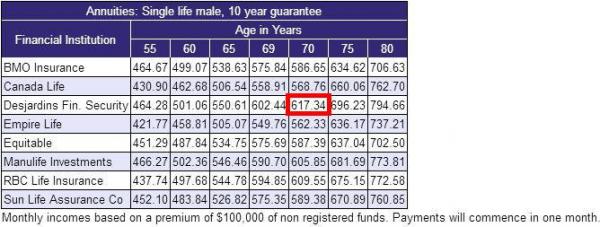
Well, if you decide to go with an annuity to get your $5000/mo, you would need about $810K
$617.34 * 8.099 = $5000/mo
8.099 * 100K = $809900
https://www.cannex.com/public/.....tc03e.html
6:45 pm
August 30, 2023
Offline
HermanH said
Alexandre said
If this were that world, I'll give all my money and assets in exchange for an annuity.
Well, if you decide to go with an annuity to get your $5000/mo, you would need about $810K
$617.34 * 8.099 = $5000/mo
8.099 * 100K = $809900https://www.cannex.com/public/.....tc03e.html
60K a year on 810K, that is a 7.4% return. Is this variable or a guaranteed return for life?
6:48 pm
April 27, 2017
Offline
zgic said
60K a year on 810K, that is a 7.4% return. Is this variable or a guaranteed return for life?
Its for life but its not “return” because a chunk of your annual payment is your own money given back to you.
Actual return will vary, depending on how long you live but will be quite a bit less than 7%.
8:13 pm
March 15, 2019
Offline
mordko said
You could have a couple of mil in a bank account in Canada, declared Canadian income of under 20K, live in a 5M house and legally claim GIS as long as you are over 65 and claiming OAS. As described above.
Some hardcore lefties are pushing for a "wealth tax". They think it is fair to tax your employment income at 53% and then tax the 47% that is left after the income tax as a "wealth" tax.
2:04 am
November 18, 2017
Offline
Alexandre: The posited justification for laws that favour unearned income is that it is a premium for taking risk. Everyone can make their own determination of how they feel about that.
savemoresaveoften: Welfare in Canada is NOT just income-tested! GiS is, and the OAS clawback, but welfare also tracks assets and previous disposal rates of assets. Those who try to hide assets by passing them on to others will be found and dinged. Ditto what CAD said.
mordko is correct about GIS.
RetirEd
5:22 am
April 6, 2013
Offline
zgic said
60K a year on 810K, that is a 7.4% return. Is this variable or a guaranteed return for life?
That is a guaranteed monthly payout for life or, for that quote, 10 years, whichever is longer.
As mordko said, it is not a 7.4% annual return. Estate doesn't get the $809,900 back at the end.
Rate of return depends on how long one lives. We did some return calculations previously. Rate of return is decent if the annuitant lives to age 100. Not so much if the annuitant lives to average age expectancy, around the middle age 80's.
5:37 am
March 30, 2017
Offline
I was thinking mainly OAS and GIS when I use the word "welfare".
But isn't it true child benefits etc are also based on income only and not asset tracked.
Honestly I don't know what other welfare may be out there, other than a low income subsidy if ones income is more than X but less than Y. Isn't that also a welfare that is income based only ?
Having been a high tax payer my entire work career, I am just sour when the time for me to collect OAS, I will be turned away by the excuse "Cuz you have done too well and a good saver/investor, even tho you paid a boat load amount of tax, you won't be entitled to any OAS"
