 Log In
 Register

 Topic RSS
 Facebook
 Twitter
 Email this
1:16 pm
December 18, 2024
 Offline


Mainly for availability of all money sooner or more money per year.
Due to unexpected death or need for more money per year or?

2:54 pm
October 27, 2013
Offline
Generally, the best overall return would be a 5 year GIC ladder but whether one does that or not depends on the account type, age (maybe), and the variety, if any, of financial institutions used. Also whether one still has the cognitive ability to manage it or one's POA has the time and motivation to manage it.
Not that I would have GICs myself, but my take would be to use the KISS principle as one ages, meaning fewer institutions and minimal proliferation of the number of GICs. The size of the GICs can be managed to mature as/when funds are needed so I don't see that being an overriding issue, subject to having sufficient funds to have to suddenly fund LTC or similar that will significantly increase living expenses.
My mother was 96 when she passed and my bro and I were still working a 5 year GIC ladder for her. We also ensured about 15% of her assets were in an equity mutual fund so that it would juice returns a bit, in addition to being an additional source of funds in event she had to be admitted to LTC.
When she passed, we requested the GICs be 'matured' during the probate process in order for estate disbursements to be made.
2:58 pm
September 30, 2017
Offline
I'm shifting to 10Y provincial bonds this year, when GIC rates is falling.
3:25 pm
January 12, 2019
Offline

GIC-Fanatic said
" As you age …. Do a 5 year ladder …. Or a 3 year ladder"
IMHO ... There's WAAAY too many possible variables, to answer that one properly.
But many will try ... just you wait an' see 
- Dean
 " Live Long, Healthy ... And Prosper! "
7:29 am
December 18, 2024
Offline
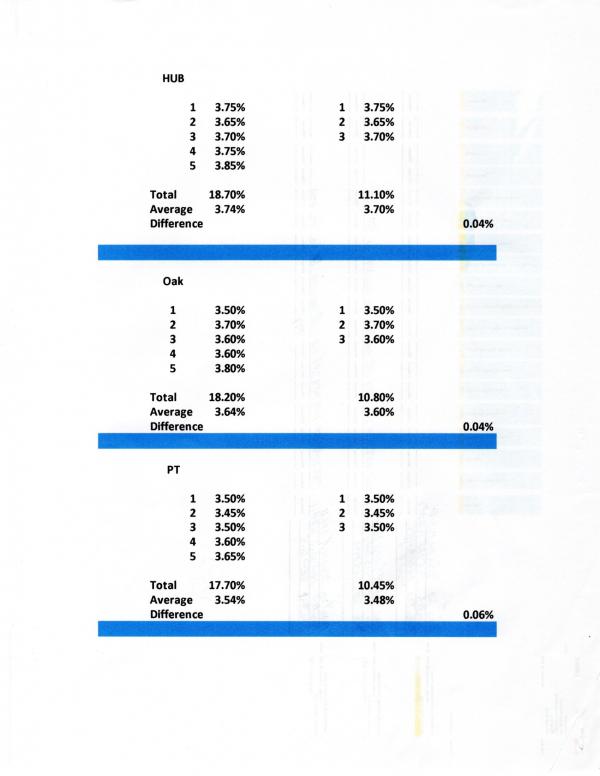
While there are a few "what ifs" this is some simple arithmetic that shows there is not much difference between and 3 or 5 year ladder.
12:12 pm
October 27, 2013
Offline
That is true today, but is it true next year? Or the year thereafter? Recency bias taints a lot of minds.
As Dean says, any such decision will be highly situational. I wouldn't do any such ladder anyway except possibly in a DIY brokerage where I can have GICs from any of 15-20 issuers, all in one account. I would not be beholden to any one FI.
6:08 am
January 9, 2011
Offline
AltaRed said
That is true today, but is it true next year? Or the year thereafter? Recency bias taints a lot of minds.As Dean says, any such decision will be highly situational. I wouldn't do any such ladder anyway except possibly in a DIY brokerage where I can have GICs from any of 15-20 issuers, all in one account. I would not be beholden to any one FI.
So well said. It starts with determining the driving force(s) behind such decisions and which are most important to you. Is it getting an additional 10 BP yield over X months, and how to determine that time frame anyway. Or is it (perceived) ease of dealing with estate matters.
Myself, for what its worth, I follow the decades old general advice about shifting investment risk types as ageing happens, ie: less % in the stock market and more cash/MM/GIC/HISA. And I extend that thinking to shortening GIC terms as my wife and I get older. Now I ladder everything in one year terms with a few 18 months and one 2 year (the recent Oaken special rate). As a by-product its been great for years now re: overall yields, but of course not anymore.
Lots of GIC expiries all the time which mostly eliminates the need to take the lower HISA rates. To protect the "cognitive ability to manage" danger, I keep a spreadsheet and a diary going. In simplicity, it's easier to remember when there's and expiry happening every 3 weeks or so. Yes the possibility of forgetting and not managing with no expiries happening for months or years has crossed my mind...
My memory's not as sharp as it used to be. Also, my memory's not as
sharp as it used to be.
8:49 am
November 18, 2017
Offline
I'm moving to 2-3 year ladders, according to rates available and "holes" in my ladder. Big decision coming next month!
RetirEd
12:36 pm
December 18, 2024
Offline
@AltaRed
Separate feed backs.
Thanks for your excellent input.
Generally, the best overall return would be a 5 year GIC ladder but whether one does that or not depends on the account type, age (maybe), and the variety, if any, of financial institutions used. Also whether one still has the cognitive ability to manage it or one's POA has the time and motivation to manage it.
Yes 5 year may be the best. It also appears, for the last years, that 1 - 5 year GIC's no longer grow in percentage rate by the increment of terms like they used to. No one seems to want to honour the highest rate for 5 years. And as you mention...I have fears of a POA (a daughter) or my survivor would never keep the type of records that I do. Nor would they maintain the excel file/summary. Chances are they might want to farm it out which I would never ever do as long as I remain capable.
Not that I would have GICs myself, but my take would be to use the KISS principle as one ages, meaning fewer institutions and minimal proliferation of the number of GICs. The size of the GICs can be managed to mature as/when funds are needed so I don't see that being an overriding issue, subject to having sufficient funds to have to suddenly fund LTC or similar that will significantly increase living expenses.
I've done the advisor route. And every time he gave me a quick report of % of gain I would ask...where did that come from? Stocks or GIC's .... answer...GIC's. So when I retired I then found this site and went out on my own; all GIC's, all safe, all higher rates and no .25% commission, all accounts are at least $4000 less than the CDIC or CU Insurance rates, and have ensured that any survivor will also not go over those insurance rates. Right now pretty much all non registered funds pay out interest annually and that keeps us in excellent financial condition. And the odd GIC, when needed, gets partially or completely cashed out. And I lost 30% of my pension but over the years has gained so am only out by 10%. My gut feels good about the 3 year ladder as it has some values. And yes the what if's are there, but they will be there as well for any contemplated change.
My mother was 96 when she passed and my bro and I were still working a 5 year GIC ladder for her. We also ensured about 15% of her assets were in an equity mutual fund so that it would juice returns a bit, in addition to being an additional source of funds in event she had to be admitted to LTC.
When she passed, we requested the GICs be 'matured' during the probate process in order for estate disbursements to be made.
We were in a similar situation with my mother in law. My wife is the executor and POA and she had most of her $ with the advisor that we "used" to have. Which worked out good. The advisor did all 5 year GIC's, no laddering, less work for him, rates sucked. We also had $30,000 in a stock that was guaranteed to gain and not lose ... like a bank account that makes .001% interest as a rainy day fund. It was never used. The advisor only cashed in GIC's when the probate letter was handed over. The closing company that the advisor used screwed up and recently sent $800 for the estate and has caused another year of not wrapping up the estate as this caused another tax year to report.
12:47 pm
December 18, 2024
Offline
@AltaRed
Separate feed backs.
Thanks for your excellent input.
That is true today, but is it true next year? Or the year thereafter? Recency bias taints a lot of minds.
Who knows. But everyone should be prepared to make changes in their "financial planning".
As Dean says, any such decision will be highly situational. I wouldn't do any such ladder anyway except possibly in a DIY brokerage where I can have GICs from any of 15-20 issuers, all in one account. I would not be beholden to any one FI.
I agree. Either a BMO Investorline or RBC Direct or some other type. I missed the boat on that one!! But I see, today, the costs/fees appear to be better. I have asked both brokerages for their GIC rates, issuers and minimum deposits. And the minimum deposit may be a weak link for me to change over. I had iTrade and dumped them years ago. And right now I have multiple FI's, with preference if they have a store front in BC.
12:58 pm
December 18, 2024
Offline
@dougjp
Separate feed backs.
Thanks for your excellent input
Myself, for what its worth, I follow the decades old general advice about shifting investment risk types as ageing happens, ie: less % in the stock market and more cash/MM/GIC/HISA. And I extend that thinking to shortening GIC terms as my wife and I get older. Now I ladder everything in one year terms with a few 18 months and one 2 year (the recent Oaken special rate). As a by-product it's been great for years now re: overall yields, but of course not anymore
Good points! Thanks. And I do think if I do go to a 3 year ladder the exception would be a 4 or 5 year GIC that had an exceptional high rate of return. But if all years go that way....I will then hit a "what if"!!!
Lots of GIC expiries all the time which mostly eliminates the need to take the lower HISA rates. To protect the "cognitive ability to manage" danger, I keep a spreadsheet and a diary going. In simplicity, it's easier to remember when there's and expiry happening every 3 weeks or so. Yes the possibility of forgetting and not managing with no expiries happening for months or years has crossed my mind...
I have an excel spreadsheet that lists every GIC we have by type, sorted by date and FI, grouped by year, and coded with where the funds originated from. And from there, to a front page over all summary that is published monthly. I also run a book type calendar (supplied by my realtor) that has noted maturities and interest payments and holds paper reminders as well. It works good for me.
1:04 pm
December 18, 2024
Offline
RetirEd said
I'm moving to 2-3 year ladders, according to rates available and "holes" in my ladder. Big decision coming next month!
Interesting!!! Looks like all of us have similar but not exactly the same thoughts.
And those holes!!! Where do they from?? ha ha. My excel worksheet even lists the laddering for me....but I forget to look at it!!
With my 3 year ladder plan...it's going to take time to do for sure. The only thing about laddering TFSA is that one or more year will always be $7500 or so higher.
2:13 pm
October 27, 2013
Offline
Remember each of the big bank discount brokerages have about 15-20 issuers of GICs albeit only about the top 5-8 have competitive rates. The 0.25% GIC commission you speak of is behind the scenes paid by the issuer to the agent (brokerage) and may, or may not, be the same at all brokerages. The posted yield is what you actually get.
It is easier for a POA to manage a GIC ladder in one place at a discount brokerage. The process to buy GICs at a discount brokerage is extremely simple for just about anyone and the 'holdings' are plain and clear to see with the maturity dates of each. No need for a spreadsheet IF everything is in one or two accounts.
I would even suggest a POA would glaze over at the mere mention of a spreadsheet. I am a P.Eng by profession and I avoid spreadsheets like the plague. If it is not simple enough to manage looking at a monthly account statement, it is too complex.
P.S. I would suggest that more than 15 GICs in a 5 year GIC ladder (9 in a 3 year ladder) are too many. One maturing every 4 months is plenty enough to manage cash flow. We had 9-10 GICs in my mother's 5 year GIC ladder and managed the cash flow just fine.
Added later: A POA is not going to be overly precise in managing a GIC ladder. Here is an example of how I would, as a POA, manage a ~$800k account based on a 5 year GIC ladder.
Firstly, I would have about 6-12 month's worth of expenses in a brokerage ISA (or MMF), e.g. RBC2010 at RBC DI or DYN6004 at Scotia iTrade, or BMO95142 MMF. That is meant to manage monthly operating expenses between GIC maturities. Let's say that is $20k that is slowly wound down in the time period to the next GIC maturity.
That leaves $780k for 10 GICs or about $78k per GIC. I don't care whether the GICs are $70k or $85k each as each of those principal values are within about +/-10% close enough to $78k for government work. Next, I would not get overly precise about maturity dates as long as they are approximately within 30 days of the 6 month intervals for GIC maturities. That might mean the time periods vary from 5-7 months. That is also good enough for government work. Nothing is to be gained being pedantic about preciseness. It doesn't earn any more money overall.
I enter the maturity dates of each GIC in my Google calendar which prompts me 7-10 days in advance of the upcoming maturity. That is all there is to it.
8:14 am
November 18, 2017
Offline
GIC-Fanatic: "Holes" in my laddering are caused by picking a non-standard time horizon to take advantage of special rates or circumstances... including filling previous holes. 
I try to keep stuff maturing about every 4-6 months is fine, and keep $5-10K relatively liquid (including cashable terms). I use a spreadsheet, of course, and mark all my GICs on my big wall calendar at the start of the year. I also have a "maturities" spreadsheet but it tends to be less used and not always up to date. My bad.
RetirEd
8:31 am
December 18, 2024
Offline
RetirEd said
GIC-Fanatic: "Holes" in my laddering are caused by picking a non-standard time horizon to take advantage of special rates or circumstances... including filling previous holes.I try to keep stuff maturing about every 4-6 months is fine, and keep $5-10K relatively liquid (including cashable terms). I use a spreadsheet, of course, and mark all my GICs on my big wall calendar at the start of the year. I also have a "maturities" spreadsheet but it tends to be less used and not always up to date. My bad.
We are both doing very similar. I am putting less in HISA and more in 30 or 90 lock ins or quarterlies. I was doing 30 day GICS on automatic renewal at Peoples but the 30 day rate no longer exceeds their HISA rate. So all GICS have been collapsed and most $ have been moved away.
