 Log In
 Register


 Topic RSS
 Facebook
 Twitter
 Email this
4:32 am
January 9, 2011
 Offline


Thanks to everhopeful for the recent post in the Motive comments, and others posting recently about doing this. It seems to make sense to consolidate for several reasons, like simplifying estate management, and/or record keeping, and perhaps other things. This thread might organize questions and answers.
A few questions I have to start this off.
- My discount brokerage account is, like most I assume, in my name alone. All my GICs currently are in joint names with my wife and linked to joint HISA's at each bank, obviously for ease of access to funds and decisions about renewing or not if one of us passes away. Is this possible to do in my discount brokerage account?
- Do CDIC insurance limits apply to each individual bank GIC, or does CDIC not even apply and only Canadian Investor Protection Fund - " CIPF ensures that if a member firm fails, property held for you is returned, including cash and securities, up to certain limits. "
- Can existing GIC's at various banks be transferred into a discount brokerage account, and without cost?
My memory's not as sharp as it used to be. Also, my memory's not as
sharp as it used to be.
5:37 am
August 4, 2010
Offline

I don't have any joint accounts, but you can certainly set those up at a brokerage, and that acount should be able to purchase GICs. You can probably also convert an existing account to a joint account, but that might require the same sort of paperwork and ID requirements a new one would, and there might be complications for existing positions in the account for ownership or deemed capital gains or something?
GICs would still have CDIC coverage - that comes via the issuing institution (although it is possible some brokerages sell GICs from provincially-insured credit unions; TDDI does not). If your brokerage runs off to Panama with your GIC funds, that would be CIPF, since the GIC's issuer isn't affected. As a bonus, GICs held through your brokerage are in a different CDIC coverage pool than ones you hold directly with that same institution, so you can have $100K at Bank X, and another $100K in GICs or ISAs from Bank X via your brokerage account.
It is unlikely that any GIC you hold directly with an issuer would be transferrable to a brokerage account - banks aren't set up to relinquish retail GICs to a brokerage, and one reason you can often get higher rates directly is because they want that customer relationship. I think even registered accounts, which have a transfer process, are exclusively for cash, not GICs in-kind, even if the institution sells similar GICs through the brokerage.
You can in some cases include GICs when transferring from one brokerage to another (nasty $150 transfer fees usually involved) - I know someone who transferred RFA Bank GICs from BMO Investorline to TDDI. It would likely depend on the exact GIC issuer and the two brokerages GIC distribution agreements. Most brokerages will be selling much the same list of GICs, at the same rates, but there will be minor differences in which institutions they distribute.
Through the brokerage, you aren't going to get some of the higher GIC rates available to direct retail customers of a bank. For instance, the highest 1-year rate through TDDI is 3.4% (TD's own, as it happens), but you can get 3.5-3.7% from various suspects if you are willing to go direct. Also, Home Trust/Bank is offering 3.35% through TDDI, but 3.5% directly via Oaken, and things of that nature. Having everything together in one brokerage account may be worth a small loss of potential direct rates.
Because of the rates and also not wanting to lock registered GIC money behind $150 brokerage transfer fees, I've pretty much done all my GICs over the years directly, with a small group of banks with high rates and no transfer fees (Oaken, Peoples, Hubert, etc). One interesting quirk where I had a small (non-TD) GIC with TDDI, because it was "in trust" in their name, they said they would be able to "split" it to contribute part "in-kind" to my RRSP - I had actually bought two separate portions on the same day for this purpose that wound up being merged into a single GIC position, to my surprise. That generally wouldn't be possible with GICs held directly at a bank, I think. Again, that sort of thing might depend on the actual GIC issuer or whatnot, so don't rely on my experience.
7:37 am
October 27, 2013
Offline
I have only ever (last 20 years or so anyway) purchased GICs (ladders) through discount brokerages such as RBC Direct Investing, Scotia iTrade and BMO Investorline, as agents for the actual issuers. The list of issuers is mostly the same between those 3 discount brokerages, and I suspect all of the big bank discount brokerages, and mostly at the same yields.
As mentioned by NR, GICs (and ISAs ) in aggregate from the same issuer at a discount brokerage are covered up to $100k CDIC insurance should one of the issuers (like Home Trust) go insolvent while one's investments in total at the discount brokerage are covered by $1M of CIPF insurance (against malfeasance or insolvency of the brokerage itself).
The brokerages are simply the agents for the GIC issuers that market GICs through the brokerage channel. The GIC issuers pay the brokerages a commission (behind the scenes) to be the vehicle to sell the GICs to the brokerage account holder and is probably the reason why yields of GICs issued through brokerages may be 10-30bp lower than the direct-to-retail channel. Example: An Oaken Financial GIC direct to retail will likely have a slightly higher yield than a Home Trust GIC via a discount brokerage (Oaken Financial GICs are not sold via the brokerage channel).
Of the 3 discount brokerages I am familiar with, the vast majority of the GIC issuers are CDIC insured banks but have seen the odd CU, like VanCity, being listed by one or more of the 3 brokerages. I suspect the brokerages will only do business with the 1-3 of the largest CUs in Canada, e.g. Van City, Coast Capital.
I believe NR is right in that it would be difficult, if not impossible, to transfer GICs in-kind from a direct-to-retail client to a brokerage, and that would likely only be possible if it was the same issuer, i.e. an Oaken Financial GIC would not be transferable but a Home Trust GIC might be transferable. As well, a Scotiabank GIC might be transferable to a brokerage listing Scotia GICs in their list of offerings but only if it was a plain vanilla 1, 2, 3, 4, 5 year GIC... not a promo, not a market lined GIC, nor any such GIC with special terms. One should thus assume it would only be an exception for a direct-to-retail GIC to be transferable to a discount brokerage.
Added: Just checked the list from 3 brokerages. BMO Investorline lists GICs from VanCity (CU insured) and Coast Capital (CDIC insured) and they make a footnote of that in the case of VanCity. RBC DI also includes VanCity in their list. Scotia iTrade currently does not list any CU. The list of issuers at each of those 3 brokerages changes somewhat from time to time and as of today might be about 70% the same issuers between the 3 brokerages.
Added yet again: I have had only one experience transferring accounts with GICs from one brokerage to another and that was circa 10? years ago when I transferred my RRSP from RBC Direct Investing to Scotia iTrade and it contained 5 GICs in a GIC ladder. I recall that all GICs transferred over but I believe they were all mainstream issuers available from both brokerages, e.g. Home Trust, Equitable Bank, Concentra Bank, etc, etc.
8:06 am
August 4, 2010
Offline
Technically, there are no "Oaken" GICs, Oaken is just a brand that Home uses for its online retail banking. The GICs are actually issued by either their Home Trust or Home Bank CDIC entities (the Oaken interface lets you choose which one you want per GIC), the same as issue their GICs on the brokerage channel. I think the main difficulty is that direct through Oaken the GICs are in your name, and in the brokerage they are in street/nominee name in trust for you. In theory it might be possible to transfer the underlying GIC from one registration to the other, but the banks have no real incentive to do this and don't have systems set up, I suspect.
Brokerage GIC customers note that not only are those GICs in a separate CDIC coverage category, but a number of other issuers have multiple CDIC entities as Home does. TD has 4 among their various mortgage and trust divisions, for instance, so you could get up to $400K of CDIC covered "TD" GICs in any particular account type. TDDI doesn't necessarily carry all the entities from their competitors (only one from RBC, multiple from BMO and Scotia), but carries all of the Home and Equitable issuers). TDDI tends to set their own rate a couple of basis points above the next highest one, to bubble to the top of the list, and since even if they are paying a commission to their banking arm, the overhead is staying in the TD family.
8:23 am
January 9, 2011
Offline
Really great information so far! I didn't think it would be possible to transfer in kind.
Two key points have been raised for me (and likely others).
First (and correct me if I'm wrong), the separate and additional CDIC coverage ceiling for the same GIC issuing bank, ie; if I have $ 99k with Oaken/Home Bank, then in the discount brokerage account I have another $ 99k issued by Home Bank. This is an easy way around the CDIC limits for those who insist their funds be covered, and timely & topical as the issue of larger CDIC limits is just beginning.
Second, again while insisting on keeping CDIC coverage and having only joint GICs, the issue of changing my existing Discount Brokerage account to joint names, or if that is even possible, and tax issues if any (like triggering capital gains). As I would remain the primary account holder with my SIN still noted on all tax forms and reporting same, my simplistic view is nothing changes and is just like my funds being placed into a new GIC in joint names. But it may not be a parallel for tax purposes....
My memory's not as sharp as it used to be. Also, my memory's not as
sharp as it used to be.
8:28 am
August 4, 2010
Offline
Also, for readers of this thread, note that "GIC brokers" are completely different from buying GICs through a stock brokerage account such as TDDI or BMO Investorline or Questrade. A GIC broker (such as GICdirect) acts as agent for a large number of GIC issuing institutions, and is the customer-facing front end only. They may get some special rates from some issuers (sometimes with higher minimum deposits), or may have access to institutions that don't deal with the stock brokerage channel.
Your financial relationship is with the GIC issuer, and if you give a cheque to the GIC broker to purchase, it is made out to the issuing institution, not the GIC broker, and payouts come from the institution through the GIC broker, not from the GIC broker's funds. They are not a trustee of the GIC in the way a stock brokerage is. This is good (funds are not on the books of the GIC broker) and bad (moving money in and out may be more of a pain).
A GIC broker may work through a network of local financial planners as their agents to do the actual customer work. GICdirect does this, for instance, although once in place, there is an online portal maintained by GICdirect (actually their parent Monarch Wealth) where you can view info on your various GICs. As I learned to my sorrow in my only interaction with a GICbroker, this data may just be coming from your paperwork with the broker and not fed directly in by the issuing institution, which may have screwed up on their end (in my case, setting up annual instead of compounding interest) which won't be apparent in the GIC broker's portal you see.
8:40 am
August 4, 2010
Offline
CDIC has an overview page regarding separate "trust" coverage. You may also see the phrase "street" or "nominee" name in some discussions regarding this. It is similar to how a brokerage holds your stocks and ETF in nominee name trusts, which lets the brokerage buy and sell them for you easily. If you actually want the a stock registered in your name with the issuer, there's extra cost and effort to get a certificate (or whatever electronic registration equivalent may exist these days).
I was a little surprised as well that GIC transfers were possible, but the trust thing would be what makes it possible, and a similar retrusteeing is happening for the equities (although different systems, I'm pretty sure). Again, people shouldn't just assume this will work, and check individual GICs with both the new and relinquishing brokerages as part of a potential transfer.
8:49 am
August 4, 2010
Offline
Most brokerages don't have their GIC lists available to the public., but here's a little chart I put together a year or two ago from various sources a year or two ago for which institutions certain brokerages carried GICs. There may be differences from then to now, and no guarantees of accuracy, etc.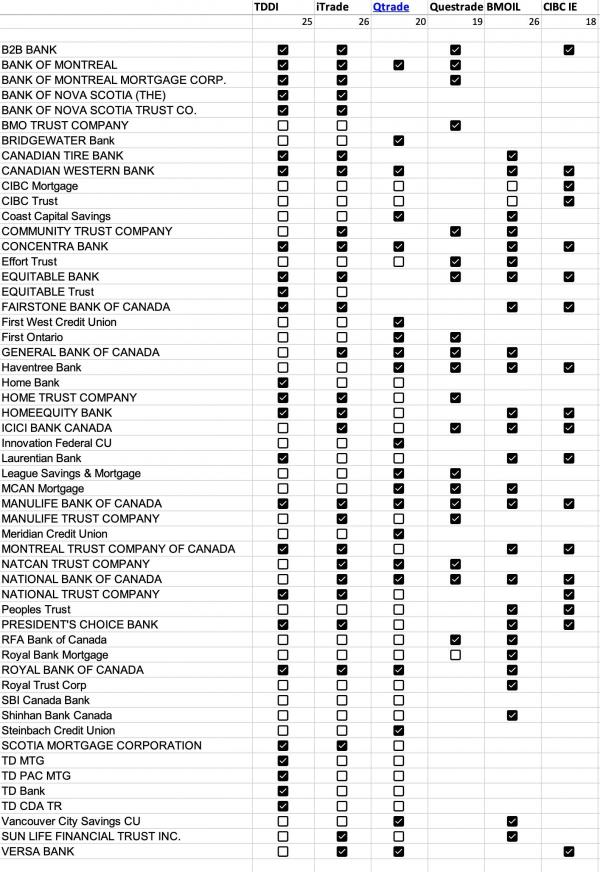
9:11 am
April 6, 2013
Offline
dougjp said
…Second, again while insisting on keeping CDIC coverage and having only joint GICs, the issue of changing my existing Discount Brokerage account to joint names, or if that is even possible, and tax issues if any (like triggering capital gains). As I would remain the primary account holder with my SIN still noted on all tax forms and reporting same, my simplistic view is nothing changes and is just like my funds being placed into a new GIC in joint names. But it may not be a parallel for tax purposes....
I wouldn't do that.
Changing the ownership of a brokerage account has the effect of a changing the ownership of all the holdings in the account. That would be seen as a deemed disposition and trigger unrealized capital gains for tax purposes. Just like changing the owners on the title of a house would.
One can have more than one account with a discount broker. One can open a new brokerage account that's joint and fund it to purchase GIC's. If one really does wish to trigger unrealized capital gains for tax purposes on certain holdings, then one can ask the discount broker to move the particular holdings from the original account to the new joint account.
The reason why there's separate CDIC coverage for the GIC's through a discount broker is that those GIC's are in the broker's name and not the account holder's name. Different owner. Separate CDIC coverage.
CDIC coverage is still needed. CIPF won't cover the funds tied up in the GIC. CIPF will only cover the cost of replacing the certificate or other evidence of the GIC that goes missing after the discount broker fails.
10:02 am
October 27, 2013
Offline
To my knowledge, a discount brokerage would require one to make a new application for a JTWROS account and then make a request to transfer-in-kind from the individual account. There are potential tax issues with the change in legal ownership of the holdings from individual to JTWROS and CRA could query it. I think it is manageable though with CRA, especially when explained that beneficial ownership remains 100% with the original owner and when reporting investment income on a T4, T5 or T5008 tax slip.
@NorthernRaven: Okay, Oaken was a bad choice for the point I was making about availability via direct-to-retail vs brokerage. I am not that familiar (current) with direct-to-retail offerings.
12:26 pm
January 9, 2011
Offline
This is all great information, thanks all !
Not wanting to gamble with or even bother getting involved with explaining anything to the CRA unless its necessary, I'm now thinking transfers in kind from individual to joint are not worth looking into.
Now the idea of a JTWROS as a new additional account to the existing Self directed account has real merit, as sort of a "CRA coverage overflow" account. Ie; when we have tapped out the acceptable (to us) GIC issuers in terms of CDIC coverage, then use cash to buy joint GICs in this new account. Otherwise there's little point in doing this, because rates are less competitive than I thought due to the hidden fees. For example at CIBC Investors Edge, a Peoples Trust 1 year GIC is 3.0%, but buying direct is 3.5%. And Corporate Bonds, Strip Bonds, Municipal Bonds etc. are the same or mostly worse.
My memory's not as sharp as it used to be. Also, my memory's not as
sharp as it used to be.
1:35 pm
September 7, 2018
Offline
Would you be obliged to file a Trust Return (T3) if and when setting up such Joint accounts - because of the new rules/requirements for Bare Trusts. I think the new rules apply to 2025, but I have not checked the status.
1:54 pm
October 27, 2013
Offline
canadian.100 said
Would you be obliged to file a Trust Return (T3) if and when setting up such Joint accounts - because of the new rules/requirements for Bare Trusts. I think the new rules apply to 2025, but I have not checked the status.
Not between spouses regardless of the relative proportion of beneficial ownership between spouses. I don't think the rules for Bare Trusts will be clear for some time yet. IIRC, there may be something in the upcoming Budget about that but I don't think anyone is getting excited/paying attention yet.
7:34 pm
September 28, 2023
Offline
Wow! Thank you all! What a treasure trove of information that has been started here in just one day! There is a ton of knowledge in the ranks here.
Thanks so much for making this thread dougjp. I now really have a big head start on the pros/cons of deciding whether to 'renew' my Motive(NB) GICs inside NBDB after the migration happens. As always, the rates at the time will probably be the final scale tipper.
These forums are amazing, and this thread is just more proof of it.
3:45 pm
September 11, 2013
Offline
As of today TD DI had a top 1-year gic rate of 3.4%, available from 4 different issuers, all in the TD group of companies. I assume the other big bank discount brokers offer pretty much the same.
So you have to decide if the slight (if any) discount is worth the extra convenience of having one account to do your gic transactions or if you want to move your money around and have accounts at the various issuers like Peoples (3.5%), Oaken (3.5%), EQ (3.4%), etc.
6:16 pm
April 6, 2013
Offline
Scotia iTRADE's top 1-year GIC rate is 3.37% from Equitable Bank and Concentra Bank.
The one-year GIC's from related issuers Bank of Nova Scotia and Scotia Mortgage Corporation are just 2.8%.
7:44 pm
October 27, 2013
Offline
I agree top rates and issuer will vary somewhat by brokerage (as noted by Norman1). For another comparison, BMO Investorline top 1 year rate today was also 3.37% from Equitable Bank and Concentra Bank with the next one being Fairstone Bank at 3.6%.
On the same list, the BMO group of companies was at 2.75% as was offerings from RBC group of companies and TD group of companies. Thus TD (post #15), through TDDI, was offering quite a bit more for GICs from the TD group of companies than BMO IL was...but that is not BMO IL's doing. That is TD deciding not to offer 3.4% through the BMO Investorline brokerage channel.
6:53 am
September 11, 2013
Offline
Today Investor's Edge also has a top 1 year rate starting at 3.37% from 3rd party issuers such as EQ, Concentra, etc. So the big bank brokerages are all offering pretty much the same, a little bit less than the very top rates listed here.
Interestingly TDDI offers TD corporate group 1 year GICs at 3.4% (as of yesterday) whereas if you go to the bank and buy it there the same GIC is 2.8% today. So they're appear to be wanting to keep their TDDI customers' funds and/or incentivizing people to open an account with them, that's a 21% premium they're paying via their brokerage channel.
11:25 am
March 30, 2017
Offline
i have seen it many times GIC rates offer by the bank (aka branch bank website etc) are always worse rate than the same bank owned brokerage.
It's like you said but also they figure out those who ends up buying a GIC thru the bank are not the most financially savvy etc compare to someone who is looking at a GIC thru the brokerage account. Thus NO need to show the highest rate, just rip off as much as the bank can.
12:33 pm
October 27, 2013
Offline
Do you think the banks should be charities then? They only offer a competitive enough rate to attract the funds they need. That is a necessary element of a profitable and successful business and what shareholders expect of management.
