 Log In
 Register

 Topic RSS
 Facebook
 Twitter
 Email this
10:17 am
December 20, 2016
 Offline


I recall discussions in the past that found market linked GIC's to be less than what they are promoted to be.
Today, in the listings on TD Web Broker, is a market linked GIC, TD CDN BANKS 5YR, S&P/TSX Bank Index, guaranteed minimum 10%, maximum return 32%.
Why does this sound too good to be true and what, if any is the risk / downside?
Is it worth considering?
Stephen
10:36 am
January 12, 2019
Offline
.
That ⬆️ "guaranteed minimum 10%" is Mighty Hard to believe❗
What's the Catch?
- Dean
 " Live Long, Healthy ... And Prosper! "
10:39 am
April 6, 2013
Offline
I suspect that is minimum of 10% per term and not 10% per annum.
10% per term for five year term is about 1.92% per annum.
10:59 am
April 15, 2015
Offline
Nehpets said
I recall discussions in the past that found market linked GIC's to be less than what they are promoted to be.Today, in the listings on TB Web Broker, is a market linked GIC, TD CDN BANKS 5YR, S&P/TSX Bank Index, guaranteed minimum 10%, maximum return 32%.
Why does this sound too good to be true and what, if any is the risk / downside?
Is it worth considering?
Stephen
I'm pretty sure the guaranteed 10% is for the full 5 years,which means average of 2% per year.Even if the market goes crazy the most you can get after the 5 years is 32% of your original investment,a 6.4% per year.Your principal after 5 years will be up minimum 10%, maximum 32%.On 1000$ investment you are guaranteed a minimum 100$ to 320$ max after 5 years.
11:45 am
December 20, 2016
Offline
Norman1 said
I suspect that is minimum of 10% per term and not 10% per annum.10% per term for five year term is about 1.92% per annum.
I chuckle at myself for reading the TD listing at face value thinking 10% per annum, inwardly knowing I had to be missing something.
Thank you for clarifying!
Stephen
1:33 pm
January 23, 2013
Offline
I think the GIC shouldn't be allowed this kind of product. Many people think it is a GIC. It is actually highly engineered Equity funds with very high fee. Not a GIC.
4:58 pm
April 27, 2017
Offline
It's a marketing gimmick. Quite misleading. For example, when they talk about “TSX index” and “bank index”, they are excluding the dividends. After 5 years bank dividends alone are quite likely to give you 30% (accounting for compounding and dividend growth).
Easy to reproduce same level of downside protection with higher potential return if you are prepared to combine a standard GIC with an equity ETF. It's a very, very conservative form of investment which screams “Heads I win, tails you lose”.
Advertising this kind of product is exactly why we love our financial industry so much.
That said, your only “downside risk” is inflation. Once you subtract taxes from 1.9% annual return, you are not guaranteed your money back in real terms.
8:46 am
April 6, 2013
Offline
Nehpets said
I chuckle at myself for reading the TD listing at face value thinking 10% per annum, inwardly knowing I had to be missing something.
…
Fortunately, you had the street smarts to suspect something.
Unfortunately, one relative didn't and loaded up on market-linked GIC's at RBC some years ago. The relative thought he was receiving a preferred GIC rate for being a long time client! 🙁
6:38 pm
March 15, 2019
Offline
"The relative thought he was receiving a preferred GIC rate for being a long time client!"
Actually, the truth is that it is new (not old loyal) clients who get the preferred rates.
I found that out with RBC's 4.7% savings interest rate. It is available to only new clients. Old loyal clients can go jump in Lake Ontario.
6:58 pm
March 30, 2017
Offline
mordko said
Easy to reproduce same level of downside protection with higher potential return if you are prepared to combine a standard GIC with an equity ETF. It's a very, very conservative form of investment which screams “Heads I win, tails you lose”.
This does not really protect ur principal which I believe the TD offering does.
For the record, I am not endorsing any equity linked notes, as the typical fee is $3 -$5 depends on the complexity of the note.
To completely mimic the downside protection, one needs to puchase a put on the index as well, and that goes beyond most are willing to do to replicate.
So this type of product does have its "intended" audience at the end of the day, just not me.
9:55 pm
April 27, 2017
Offline
savemoresaveoften said
mordko said
Easy to reproduce same level of downside protection with higher potential return if you are prepared to combine a standard GIC with an equity ETF. It's a very, very conservative form of investment which screams “Heads I win, tails you lose”.This does not really protect ur principal .
Yes, it does.
4:20 am
March 30, 2017
Offline
mordko said
Yes, it does.
not sure I follow. I am referring combining a GIC + ETF wll mimic the return but not 100% principal protection (the portion invested into the ETF)
4:42 am
April 27, 2017
Offline
savemoresaveoften said
not sure I follow. I am referring combining a GIC + ETF wll mimic the return but not 100% principal protection (the portion invested into the ETF)
Really? It's 2 simple steps:
1. Invest 90% in a 4.01% GIC.
2. Invest the remainder into an index ETF.
You get a guaranteed 10% return, no upside constraint and a high likelihood of getting 32% return. And less tax.
In fact you get “principal protection” by putting 82% in a GIC. And that's assuming that an index like TSX or S&P could go to zero. Which I guess it could but in that scenario so will your market linked GIC and all other GICs.
10:06 am
December 18, 2024
Offline
While I’ve seen some ads that are buyer beware and somewhat deceiving, this one appears to be advertised by Vancity quite decently.
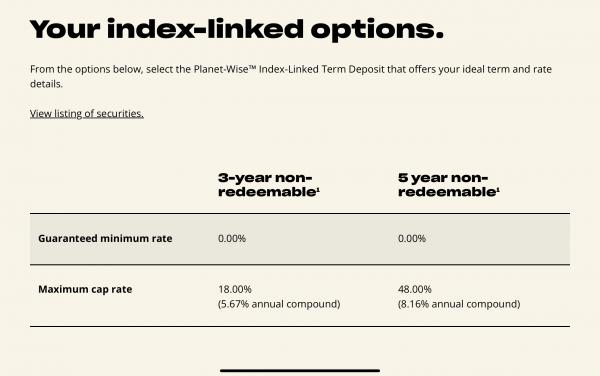
Has a specific enrolment period.
When to invest:
Like scoring tickets to your favourite show in town, you can only invest in index-linked term deposits at special times of the year. The sales period will run from July 22nd – September 22nd, 2025.
And no, I am not interested.

4:25 pm
December 20, 2016
Offline
As I read more about these market linked GIC's, I noticed the one's I've seen provide for annually compounded interest, excluding an annual payout option.
What would be the rationale for limiting the payout options for this type of instrument?
Stephen
4:37 pm
April 6, 2013
Offline
There's no annual payout option for market-linked GIC's because there is no determinable annual accrual of gains in the prices of the underlying stocks or indices that the payout at maturity is calculated from.
In fact, the payout at maturity is not known until maturity, unlike the payout of a non-market linked strip bond or the payout of a traditional fixed-rate annual compounding GIC.
5:59 pm
March 15, 2019
Offline
Maybe I'm old fashion but my preference is to just buy the stock/market directly. That way I get 100% of the dividends and capital gains. Of course, I also take the risk of a capital loss.
For those who may not be aware, Ottawa recently took away capital gains treatment for PPN's (principal protected notes).
I hasten to add that I still don't understand how some notes can pay 150%, 200% or even 300% of the upside.
7:14 am
March 30, 2017
Offline
mordko said
Really? It's 2 simple steps:
1. Invest 90% in a 4.01% GIC.
2. Invest the remainder into an index ETF.You get a guaranteed 10% return, no upside constraint and a high likelihood of getting 32% return. And less tax.
In fact you get “principal protection” by putting 82% in a GIC. And that's assuming that an index like TSX or S&P could go to zero. Which I guess it could but in that scenario so will your market linked GIC and all other GICs.
$90 in GIC nets u $18 return on $100 principal ignoring compounding over 5 years
$10 ETF goes to 0% worst case.
So combined total return = $8 or 8%, slightly less than the guarantee min 10% on $100 = $10. Not saying bank EFT goes to zero, or like u said banks EFT goes to zero, means end of world.
To max it at 32%, need 140% return on the $10 ETF. Assume 4% annual div for 5 years, need a capital gain of 120% over 5 years, ignoring compounding means 24% annual return for 5 years straight, unlikely.
In other words, the allocation to EFT needs to be way more than 10% of principal to try to max 32% total return, which means a put is need to "fully protected" the principal
8:21 am
April 27, 2017
Offline
savemoresaveoften said
$90 in GIC nets u $18 return on $100 principal ignoring compounding over 5 years
$10 ETF goes to 0% worst case.
So combined total return = $8 or 8%, slightly less than the guarantee min 10% on $100 = $10. Not saying bank EFT goes to zero, or like u said banks EFT goes to zero, means end of world.To max it at 32%, need 140% return on the $10 ETF. Assume 4% annual div for 5 years, need a capital gain of 120% over 5 years, ignoring compounding means 24% annual return for 5 years straight, unlikely.
In other words, the allocation to EFT needs to be way more than 10% of principal to try to max 32% total return, which means a put is need to "fully protected" the principal
You are ignoring compounding? That’s your first error. Without that blatantly wrong approach you already got $110 just off your $90.
And then it spreads from there ending up with obviously wrong answers. ETF needs total annualized return of 17.07% to get you to $132. That's total return , including divs. Which is high, historically exceeded in 25% of consecutive 5-year periods for S&P500.
Of course market linked gic does not guarantee $132 either, it only guarantees that you won’t exceed $132 and that you will pay your marginal rate of tax on anything over $100. So, in a taxable account you don’t need 17% return to be even with the “best possible scenario” for this market linked GIC net of tax.
But your conclusion is completely off. Because the principal is protected even with an $82 GIC and the rest invested. Bye.
