 Log In
 Register


 Topic RSS
 Facebook
 Twitter
 Email this
7:51 am
December 20, 2016
 Offline


kevhaw said
..... Meridian has a "gotcha" clause. Before you can get their high rate promotional GIC's, you have to use "new money.".....
Exceptions have been known to occur...
2:32 pm
March 2, 2015
Offline
I will renew a GIC for 1 yr tomorrow in my registered TDDI acc.
Though the available one year rates are crappy (as of today),
I am inclined to think TD monthly compound 2.14% reinvested is better than Equitable annual compound 2.17%.
Anyone care to comment ?
3:22 pm
September 30, 2017
Offline
With TDDI TD1M GIC, interest is paid out in cash monthly.
4:51 pm
March 2, 2015
Offline
Actually I thought maybe the 1 yr TD monthly compound 2.14% with the interest monthly reinvested, that the effective yield might be higher than the Equitable annual compound 2.17%, but seems the TD monthly compound effective rate is around 2.161%
8:32 pm
November 19, 2022
Offline
So I were to open 10 y GIC at 5% with annual compounding the effective rate would be 6% ? Thanks.
12:52 am
April 6, 2013
Offline
No, 5% per annum compounded annually is exactly 5% per annum compounded annually.
5% per annum compounded monthly is about 5.12% per annum compounded annually.
At most is 5% per annum compounded continuously. That's about 5.127% per annum compounded annually:
e5% - 1 = e0.05 - 1 = 1.051271 - 1 = 0.051271 = 5.1271%
5:59 am
November 19, 2022
Offline
Norman1 said
No, 5% per annum compounded annually is exactly 5% per annum compounded annually.5% per annum compounded monthly is about 5.12% per annum compounded annually.
At most is 5% per annum compounded continuously. That's about 5.127% per annum compounded annually:
e5% - 1 = e0.05 - 1 = 1.051271 - 1 = 0.051271 = 5.1271%
I don’t think your math is accurate.
When if I use the compound interest online calculator I get 6.2%
8:05 am
April 6, 2013
Offline

That's your misinterpretation of the results.
$10,000 becoming $16,288.95 in 10 years is not 6.289% per annum compounded annually.
It is
10√$16,288.95 / $10,000 - 1 = 10√1.628895 - 1
= 1.05000 - 1
= 0.05000
= 5.000% per annum compounded annually
$10,000 invested at 6.2% per annum compounded annually would become
$10,000 x (1 + 6.2%)10 = $10,000 x 1.06210
= $10,000 x 1.8249256166
= $18,249.256166
9:18 am
November 19, 2022
Offline
I should’ve worded my question differently.
5% annually compounded for 10 years is the same as simple annual interest of 6.2% for 10 years.
Thanks.
10:21 am
March 30, 2017
Offline
UkrainianDude said
I should’ve worded my question differently.
5% annually compounded for 10 years is the same as simple annual interest of 6.2% for 10 years.
Thanks.
1.05^10 = 1.6289 if that’s what u meant.
12:47 pm
November 19, 2022
Offline
savemoresaveoften said
1.05^10 = 1.6289 if that’s what u meant.
You bet.
6:59 pm
September 5, 2023
Offline
I noticed that at the same FI the Compounded Annual GIC interest rates are the same as Annual (noncompounded) rates.
According to previous discussions (and grade 5 math class) compounded Annual GICs will always produce higher returns than the 'simple' interest rates for (noncompounded) Annual when the rates are the same?
What are some reasons someone would invest in the Annual (nonpcompounded) GICs IF and WHEN the advertised compounded rates are the same for e.g. a 5 year term?
Am I missing something?
7:13 pm
October 27, 2013
Offline
1. Some people (seniors) need the ongoing annual interest from each GIC to meet annual cash flow needs and/or to budget more easily.
2. While compound GICs benefit by paying interest on top of accrued interest, this is mostly beneficial in registered accounts where income taxes do not have to be paid on accrued (but not paid) interest annually that would be the case in non-registered accounts.
7:29 pm
September 5, 2023
Offline
OK thank you for the explanation. That does make a lot of sense.
I am in a privileged position of not needing the cash flow in the short term and having room in tax free accounts, will probably invest in compounding GICs after double checking the calculations.
7:50 pm
April 27, 2017
 Online
Another way of looking at it is that by letting interest compound one effectively increases duration.
If you have interest paid annually, it could be reinvested into something else. If its another GIC then return could be higher (or lower) vs letting the interest compound, depending on options available in the future.
8:05 pm
October 21, 2013
Offline
The rates for compounded vs simple will always be the same for GICs with annual rate. Simple means the interest comes out of the GIC account, that's all; it's then up to you what to do with it - you may spend it, pay your taxes, or invest it elsewhere at higher or lower rate than previous gic.
Annual payout is often recommended so that nobody has to pay tax on income they can't access.
8:12 pm
September 5, 2023
Offline
Thank you for the additional information of duration and interest reinvestment
To provide context, the FI I was referring to is Scotia McLeod
Offering 5% Annual and 5% Annual Compounded GICs, 5 years
(annualized interest rate of 5.45%)
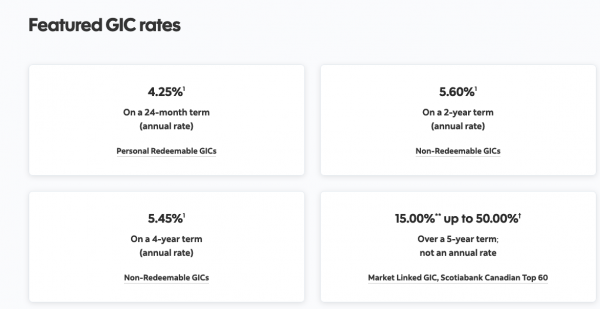
I also see that the Scotiabank GIC page has a 4 year GIC at 5.45%
9:34 pm
April 6, 2013
Offline
althisa said
…According to previous discussions (and grade 5 math class) compounded Annual GICs will always produce higher returns than the 'simple' interest rates for (noncompounded) Annual when the rates are the same?
Actually, the rate of return is the same with an annual compounding GIC as with an annual paying-out GIC with the same rate.
One ends up with more money with the annual compounding GIC because one has been adding the annual interest to the GIC's principal each year. It is not because the rate of return is higher.
The discussion above is for an annual compounding GIC versus a monthly compounding GIC of the same per-annum rate.
