 Log In
 Register

 Topic RSS
 Facebook
 Twitter
 Email this
3:02 pm
January 12, 2019
 Offline


.
The article is about 'Time & Wealth-Building' ... something most of us here are well aware of. Unfortunately, many young adults are not aware of it . . .
- FP Article Link ➡ https://financialpost.com/weal.....tors-lives
.
Dean
 " Live Long, Healthy ... And Prosper! "
1:52 pm
January 12, 2019
Offline
.
Sadly, I'm guessing they Still don't teach this stuff in High School. 
- Dean
" Live Long, Healthy ... And Prosper! "
2:13 pm
December 18, 2024
Offline
Here's another good one....offered free by RBC. What...free??? No fees???
https://www.rbcdirectinvesting.....barber.pdf
Wealthy Barber in PDF.

12:01 pm
January 12, 2019
Offline
- Thanks for that ⬆
I still have Chilton's original paperback, from Way Back in the early 90's . . .
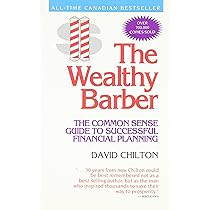
It's quite dated now. Among other things, it predates TFSAs & ETFs, and spends a Lot of time promoting the 'Benefits' of Mutual Funds.
Sadly, it's not much more than a collector's item now. But of course the Basic fundamentals of financial planning he promotes, still apply today.
- Dean
" Live Long, Healthy ... And Prosper! "
12:16 pm
November 18, 2017
Offline
The Financial Post article contains many distortions common to discussions of long-term growth. It does mention the race against inflation, but as usual the curves and assumptions call for long-term growth double or triple what savers can actually achieve - 8% in this case.
And it doesn't even account for taxes.
If one wants to end up with more money than when one started, one needs to either carefully select the best deposit rates, avoid fees and - ultimately - take risks.
RetirEd
4:15 pm
April 27, 2017
Offline
RetirEd said
The Financial Post article contains many distortions common to discussions of long-term growth. It does mention the race against inflation, but as usual the curves and assumptions call for long-term growth double or triple what savers can actually achieve - 8% in this case.And it doesn't even account for taxes.
If one wants to end up with more money than when one started, one needs to either carefully select the best deposit rates, avoid fees and - ultimately - take risks.
He is talking about investors rather than savers. The example is to illustrate the concept of money weighted rate of return, which translates variable investment returns into an equivalent of saving rate. And it's an extract from a book, I am sure taxes are covered.
10:31 am
January 12, 2019
Offline
.
- This ⬆
.
It states right in the article, that those words & quotes are from the book
'The Algebra Of Wealth' that the author wrote.
Never judge an article, by the book you don't see. 
- Dean
" Live Long, Healthy ... And Prosper! "
