 Log In
 Register


 Topic RSS
 Facebook
 Twitter
 Email this
7:02 pm
January 11, 2020
 Offline


Maybe the smallish Ontario credit unions can show the CDIC how it’s done when it comes to coverage.
8:03 pm
March 15, 2019
Offline
Rail Baron said
Yes - that link contains the email address where the Dept. of Finance is receiving input in both official languages.
Here is the full message that I wrote:
Hello,
I respectfully submit that your department's proposed increase in CDIC coverage for individual accounts to $150,000 is too low.
$250,000 would be a more appropriate insurance limit, given the long delay in increasing CDIC limits since 2005. Twenty years is far too long to wait in increasing insurance.
I now have many more accounts with banks and credit unions than I'd otherwise have if insurance limits had increased over the past 20 years. These multiple accounts do little to help me, or the banks and credit unions that issue them to me.
Whatever the new limit is, it should also come with an automatic annual adjustment that matches the increase in CPP or OAS benefits to account for inflation. That way, there will not be another two decade gap in keeping Canadians' savings adequately insured.
Thank you for considering this input,
I suspect the big banks will be against the increase in CDIC coverage because this means their CDIC premiums will increase and they think that increase coverage will likely mean depositors will chase the higher deposit interest rates offered by the smaller institutions.
8:10 pm
December 18, 2024
Offline
If Tfsa plus RRSP/RRIF is merged….I am screwed!!
In August I will have our TFSAs finally in line so if spouse dies and the other becomes the successor…..the combined amount will be under $100,000 at every FI.
So keep that in mind …. Being a successor!

11:00 pm
September 29, 2017
Offline
Wrayzor said
If the merged category has unlimited coverage, how would that reduce total coverage?
OOPS! You are correct. I guess I read that wrong. Sorry! Thanks for catching that.
7:09 am
March 14, 2023
Offline
GIC-Fanatic said
If Tfsa plus RRSP/RRIF is merged….I am screwed!!In August I will have our TFSAs finally in line so if spouse dies and the other becomes the successor…..the combined amount will be under $100,000 at every FI.
So keep that in mind …. Being a successor!
I don't think you would be screwed with unlimited coverage for the merged category - just ended up doing some work you wouldn't have had to do if the proposed change been in effect.
8:06 am
December 18, 2024
Offline
Wrayzor said
I don't think you would be screwed with unlimited coverage for the merged category - just ended up doing some work you wouldn't have had to do if the proposed change been in effect.
Thanks.
8:08 am
December 18, 2024
Offline

From two different URLs.
Specifically, the department is considering the following potential improvements and would like to hear your views:
1. Increasing the deposit insurance limit to $150,000 per deposit category;
2. Providing a deposit insurance limit of $500,000 per deposit category to non-retail depositors;
3. Extending coverage for temporary high balances for depositors experiencing significant life events, for an enumerated list of life events; for a period of six months; and with a deposit insurance limit of $1 million;
4. Streamlining the framework to four categories by merging the registered and tax-free categories and making coverage for the merged category unlimited; and
5. Enhancing depositor understanding through improved disclosure to require that a CDIC member institution provide its customers with tailored information explaining the amount of insured deposits that are held at that member institution for that customer.
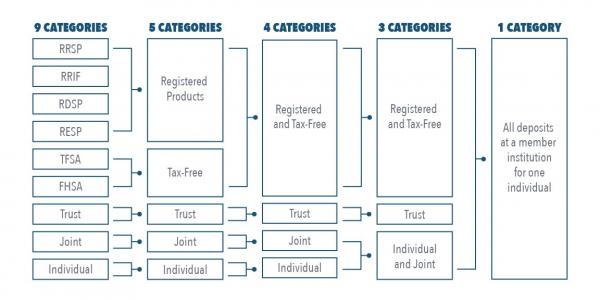
So point #:
1. Refers to “as is” category 9?
2. Non retail is a specific individual? For category 9?
3. Is good!
4. Is category 4. And is excellent. But what is coverage for trust, joint and individual?
5. Hmm that’s good. Like a downloadable report that’s updated monthly.
Sure would be nice if every CDIC FI produced a certificate like Oaken and then added that is covered by CDIC and drop the “eligibile” wording.
8:19 am
September 11, 2013
Offline
So what does that mean? If I have an RRSP, a TFSA and a bank account at a bank I have unlimited coverage in all 3 accounts?
9:00 am
April 6, 2013
Offline
Bill said
So what does that mean? If I have an RRSP, a TFSA and a bank account at a bank I have unlimited coverage in all 3 accounts?
No, merging the registered categories to reduce the total deposit categories to four would give unlimited coverage to just the RRSP and TFSA.
The non-registered bank account would still be in a separate category (Individual) that has a coverage limit.
The Framework Simplification has two proposals:
- The department is considering streamlining deposit insurance categories to four categories by merging the registered and tax-free categories.
- The department is considering making deposit insurance coverage for the merged registered and tax-free category unlimited (i.e., no limit).
Proposal #2 is one solution to a consequence of Proposal #1. It is not the only possible solution. For example, a $1 million limit, instead of unlimited, for the merged categories could also address the reduce coverage from Proposal #1.
Unlimited deposit coverage is not conidered to be a good idea. This is from section 2.1 International Guidance of the discussion paper:
The International Association of Deposit Insurers has established Core Principles of Effective Deposit Insurance Systems (see link at the end of this document). These guidelines state that the level and scope of deposit insurance coverage should be credible but limited.
Specifically, most depositors across insured institutions should be fully protected, in order to minimize the risk of bank runs. With the protection offered by deposit insurance, depositors are less likely to withdraw their funds in times of perceived or real stress, thus reducing the risk of bank runs and potential contagion across the financial system.
At the same time, a substantial proportion of the value of deposits should be left unprotected and therefore exposed to market discipline. Market discipline refers to the fact that uninsured depositors are exposed to the risk of loss in the event of a bank failure. Therefore, depositors who have funds not covered by deposit insurance have an incentive to monitor the performance and risk management practices of the member institution and to keep their funds in a member institution they consider to be safe.
Depositors holding large value deposits are generally viewed as best positioned to monitor risk-taking by financial institutions and exert this market discipline, given they are considered to have the financial sophistication needed to judge the soundness of a financial institution.
9:04 am
December 18, 2024
Offline
Norman1 said
Bill said
So what does that mean? If I have an RRSP, a TFSA and a bank account at a bank I have unlimited coverage in all 3 accounts?No, merging the registered categories to reduce the total deposit categories to four would give unlimited coverage to just the RRSP and TFSA.
The non-registered bank account would still be in a separate category (Individual) that has a coverage limit.
The non-registered bank account would still be in a separate category (Individual) that has a coverage limit
Re above……A coverage limit in the amount of?
9:41 am
April 6, 2013
Offline
The coverage limit for the Individual category is not part of the Framework Simplification.
Other proposals deal with that coverage limit. The limit could be left at the current $100,000 or be increased.
12:18 pm
August 4, 2010
Offline
- Annual CPI indexing of CDIC limits is a non-starter. Coverage limits are somewhat arbitrary numbers, unlike say one's pension or marginal tax rates, and frequently invalidating all the existing numbers provides no great compensating benefit. Set it at a nice round number, and adjust it to another nice round number maybe once a decade if needed.
- Between the consultation paper and the CDIC annual report, it doesn't look like there's a way to determine the uninsured amounts in the registered coverages. But I doubt it is terribly high, given plan limits and participation rates, joint ownership, multiple issuers, and potentially higher coverage. A small amount of monstrous GIC ladders or whatever aren't going to move the needle much, it is all "retail" customers, and that sort of thing isn't really hot money or providing counterbalance to moral hazard. It is probably simpler just to say that registered coverage is unlimited rather than put a (different) limit on it for no real advantage - those sorts of accounts shouldn't be providing a lot of low-level financial discipline in the system.
- Again, it doesn't look like one can determine the proportion of non-retail in the insured base is. But at the higher $1M proposal, 99% of current accounts would be fully covered, but only 20% of the non-retail deposits. That leaves a smaller number of smarter big whale corporate and whatever accounts to provide market steering.
- The temporary high balance/life event stuff looks like it might take a fair bit of administrative overhead, but if they can make it work, is probably good. That sort of stuff isn't going to drive banking or client behaviour, and it would provide peace of mind with probably little or no additional resolution risk.
Things are a bit different in the US with many more institutions and volatility, but for Canada I'd definitely prefer concentrating on coverage rules that provide actual significant behaviour benefits, and not just "performance theatre".
2:20 pm
January 12, 2019
Offline
.
More on the proposed CDIC coverage increases . . .
- FP's Take On The Subject ➡️ https://financialpost.com/fp-f.....ts-failure
.
There's definitely Lots to chew on❗
- Dean
 " Live Long, Healthy ... And Prosper! "
10:36 am
November 18, 2017
Offline
One can also look at the lower limits encouraging bank competition and diversity of deposits. Which lowers risk to retail depositors.
RetirEd
5:51 pm
March 15, 2019
Offline
"Extending coverage for temporary high balances for depositors experiencing significant life events, for an enumerated list of life events; for a period of six months; and with a deposit insurance limit of $1 million;"
Interesting concept. This will come in handy when I win the $100mm lottery. Just kidding!
Question: Are lottery winnings still tax-free?
6:12 pm
December 18, 2024
Offline
COIN said
"Extending coverage for temporary high balances for depositors experiencing significant life events, for an enumerated list of life events; for a period of six months; and with a deposit insurance limit of $1 million;"Interesting concept. This will come in handy when I win the $100mm lottery. Just kidding!
Question: Are lottery winnings still tax-free?
Good for an estate account for probate. And is to your benefit to only have one estate account.
10:24 am
November 18, 2017
Offline
COIN: GOVERNMENT lottery winnings are still tax-free. Interest they earn is not. And private lotteries are not.
RetirEd
12:27 pm
October 27, 2013
Offline
GIC-Fanatic said
Good for an estate account for probate. And is to your benefit to only have one estate account.
Indeed it is, but I suppose only to the extent one is not with a big 6 bank for that estate account. I see no issue whatever having 7 figures in a big 6, or at least a big 5, estate bank account.
6:35 pm
March 15, 2019
Offline
RetirEd said
COIN: GOVERNMENT lottery winnings are still tax-free. Interest they earn is not. And private lotteries are not.
Thanks. Many years ago I did the tax returns for an American citizen living in Canada. On his Canadian return I did not have to report his lottery win but I did on his U.S. return. His lottery win was $250,000. (I forgot if he got the full (or some) credit for his U.S. taxes on his Canadian return.)
9:42 pm
April 6, 2013
Offline
Likely no credit against Canadian taxes if there are no Canadian taxes on the income.
The principle is that any foreign taxes on foreign income are credited against Canadian taxes on that foreign income. So, if there's US tax on some gains in a TFSA, then there is no credit towards Canadian taxes as those gains in a TFSA are tax free in Canada.
